Ojai has
always had great pride for its many tree-lined streets
by David Mason
"I think that I shall never see
A poem lovely as a tree.
A tree whose hungry mouth is prest
Against the earth's sweet flowing breast;
A tree that looks at God all day,
And lifts her leafy arms to pray;
A tree that may in Summer wear
A nest of robins in her hair;
Upon whose bosom snow has lain;
Who ultimately lives with rain.
Poems are made by fools like me,
But only God can make a tree."
- Joyce Kilmer, 1913
From the editorial pages of the Honolulu Bulletin in 1899: " street
trees, which, though inarticulate and immobile, seem to have exercised
the daily papers of this city to the extent of columns of their space.
It is not alone the poetry of youth that should implore the woodsman to
'spare that tree,' but the good sense of all. Does the tree really offend
anyone? What would Honolulu be without its shade trees - the grandest trees
I have ever seen? Who would care to live here if there were no shelter
from the tropical sun? Could the dumb animals that work upon the streets
of this city speak, I am sure they would plead harder that the tree be
allowed to stand where its shade might still give them refreshment - I
am sure they would plead harder than any human is likely to."
The Hono-lulu editor, using the Ojai Valley as an example, said: "Allow
me to refer to the village of Nordhoff (now Ojai), in Ventura County, California.
Nordhoff has a very warm summer climate, which has naturally caused the
people to prize their fine oak shade trees. The village is built under
the trees, which are allowed to stand wherever they chanced to grow. If
they are in the street, the people drive around them, saying the trees
were there first and shall not be molested. How grateful the shade of those
trees is to man and beast can be understood when the love of the people
for the tree is known."
The Honolulu Bulletin continued its report: "In Ventura County, woe
to the man who lays his ax to any tree upon a public road. There the trees
as well as the people are protected, and if an overhanging limb gets too
familiar with passersby, an order from the supervisor of the district must
be obtained before the offending part of the tree can be removed."
From the first settlers of the Ojai Valley, a strong regards toward
the trees has been felt by all. In 1882, when Charles Nordhoff, for whom
the town was originally named, wrote about the splendor of the valley,
he said: "The valley is famous even in California for the abundance and
loveliness of its woods of evergreen oaks. It presents the appearance,
in fact, of a magnificent old English park; the oaks dot the surface of
the whole lower valley, and are scattered over it in single specimens and
clumps - the perfection of what in England is called the 'natural' style
in landscape gardening."
In 1922, the beautiful Arbolada section of the valley was created for
the sole purpose of saving the trees. Edward Libbey, Ojai's greatest benefactor,
purchased the large ranch to save the trees from being destroyed and, in
his developing of the Arbolada, he insisted that no trees be removed, the
streets were laid out to curve around them.
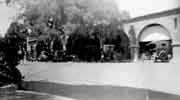
Another project, the redesigning of the downtown of Ojai, with the
addition of the arcade, post office tower and pergola, a great amount of
care was taken to prevent any damage to the existing trees that grew along
the roadway. The trees were pruned just enough to allow the arcade structure
to be built. The green foliage softened the long row of arches and added
a welcome break in the block-long building. The trees also brought comfort
on the hot summer days.
But by the 1920s, the popularity of the automobile would change the
opinion of the city fathers toward the beautiful trees that grew along
the city streets.
On July 2, 1926, after most of the street trees in downtown Ojai had
been removed, the local newspaper, The Ojai, reported: "It was pointed
out by the city attorney that the two oaks in front of Boardman's drug
store (now Village Pharmacy) and the pool room (now Primavera), and the
oak tree in front of the jewelry store (now Rains) all constitute menaces
to traffic, and since they have all been hit several times, which is testified
by their scarred trunks, and since they are all three in a poor condition,
it was ordered that the city marshal be instructed to have them cut down."
The City Council expressed its regret that the removal of these trees
had become necessary: " but because of the accident of last winter (1925),
when a car from Santa Barbara collided with a sycamore tree that then stood
in front of the city fire station (now Alexander David's), it was agreed
that these trees should come out in the interest of the public safety."
The city manager said that it probably would be some time before the work
of cutting them down would actually take place; the city workmen were all
busy picking fruit.
The Ojai Valley Garden Club requested that the city postpone the cutting
of the trees. Members of the Garden Club appeared before the City Council
meeting to inquire as to what might be done to save the trees. The city
attorney advised them that the only means of saving them would be for the
club to provide insurance for possible claims against the city because
of accidents involving the trees.
The city decided that nothing would be done toward the removal of the
trees for 30 days, giving the Garden Club time to ascertain whether or
not it would be feasible for them to insure the city against any claims
brought against them because of the oaks. The Garden Club was unable to
insure the city and the trees were removed. The safety of the automobiles
had won out.
Two years later in 1928, the pepper trees lining Ojai Avenue in front
of the grammar school (now Ojai Unified School District offices and Chaparral
High School) would create another tree protest.
The local newspaper reported: "The sight of workmen chopping away at
the roots of the pepper trees in front of the grammar school Monday morning
precipitated an avalanche of protest down upon the heads of the school
board in an effort to postpone the work until a meeting could be held to
discuss the matter and ascertain the wishes of the public." The meeting
with a heated lengthy discussion was held.
A number of parents, citizens of the district and others met with the
school board to talk over the matter and to ascertain whether the remaining
trees could be saved. The chairman of the grounds committee explained that
new plans had been drawn up for the landscaping of the front of the school
yard which called for the removal of all but five of the trees. The chairman
voiced his opinion that: "The trees were unsightly, planted too close together
and not needed for shade since there were large oaks at the (Montgomery
Street) side and another row of pepper trees on the east side of the school
yard."
The next day after the meeting, more trees were removed, with the result
that a petition was circulated protesting the removal, to which 164 names
were secured. The school board president said, " he considered it the duty
of the board to abide by the wishes of the majority of the people and that
he was not in favor of removing the trees because of the strong sentiment
against it." He then tendered his resignation to the board, saying that
he did not like the way certain things had been done.
As the protests continued to mount, the school board agreed to stop
cutting the trees until the grounds committee could get together to decide
their actions. The next day, under orders from the school board, at 5:30
in the morning while the valley was still sleeping, the workmen cut down
several more of the trees. The protesters felt that since the school board
had broken its word in not waiting, they began discussion of a recall of
the board. The next day, at a meeting of the school board, it was agreed
that all further action with regard to the cutting of the grammar school
trees would stop.
The remaining pepper trees, which were a turn-of-the-century beautification
project, still line the street in front of the grammar school - and where
they had once created a tree-lined avenue from downtown to Gridley Road,
are today just a few scattered trees along the roadway.
No matter how busy we become or how progressive we feel our thinking
is, the Ojai Valley's love for each of our trees only grows stronger as
the years go by.
© 2000 The Ojai Valley News
Back
to the news |
|
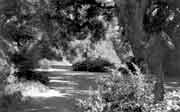
THE DENSLY
SHADED ENTRANCE to Libbey Park shows where the fountain is located today
- 1940.
|
|
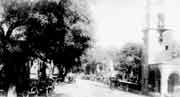
THE BEAUTIFUL
TREE-shaded town of Ojai - 1919.
|
|
THE ARCADE
SHADED by a few mighty oaks that grew alongside - 1921.
|

|

