Even in
the early days, hospitality was keynote at 'The Ojai'
by David Mason
"This being tennis week, the hotels of the valley are crowded to their
utmost capacities. Some of the regular boarders at the Ojai Inn 'doubled
up' in order to make room for the throng of young tennis players. At the
Foothills Hotel, we were told, the billiard table was even made up as a
bed."
- The Ojai, April 7, 1906
As the excitement gathers for the 100th Ojai Tennis Tournament, which
will be held this year on April 27 through 30, a lot of time has been spent
in remembering the tennis games of the past years. The first tournament
was actually held in 1896, but was eliminated during a few of the early
years.
In 1949, the 50th Tennis Tournament, "Golden Jubilee" as the famous
author David Lavender referred to it, was centered around curious bits
of lore that emerged from the first tournaments.
From the beginning, hospitality had been the keynote. It had to be.
Since there wasn't even a train into the valley until 1898, the early contestants,
arriving from Los Angeles, Pasadena and San Francisco, had to travel by
stage across the mountains. When the train did start to run into the valley,
many of the players still preferred to travel by buggy, some coming over
the Casitas Pass from Santa Barbara.
Players arriving after dark were usually met by members of the tournament's
hospitality committee, bearing lanterns and driving buckboards in which
to convey the visitors to shelter. The Ojai people took the players into
their homes and it helped to make the tournament fun and enjoyable for
all.
In the early days of the tournament, the refreshments were quite conventional;
ice cream and cake were sold under the live oaks of the park by the ladies
from the various valley churches.
In 1904, the refreshment booth, which was garlanded with wildflowers,
gave way to a very unconventional substance, when players and spectators
were served afternoon tea. This custom has never died, although the flowers
garlands did in the 1920s, when the spread of cultivated land in the valley
made wildflowers difficult to secure.
The booth was replaced by a pavilion-style tent in 1925 and the Tea
Tent then became the tournament's social center. Massive silver heirlooms
graced the serving table, while gallons of tea were poured and bushels
of cookies were distributed to the guests.
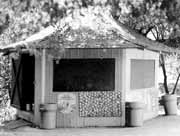
The orange juice stand, an hexagonal hutch which was located on the
east side of the courts, dispensed orange juice during the day when the
tea tent wasn't open. The little stand was the happy by-product of the
depression of the 1930s. Citrus was cheap then, and when someone thought
juice would make a welcome addition to the tournament, the local packing
house donated several dozen crates of fruit.
Originally, the orange juice stand was to be done only one year, but
its success was so overwhelming, it was continued. Indeed it had been the
salvation of some youthful players who had exceeded their allowances. One
year, for example, Jack Kramer of Montebello High School, who had not yet
gained his reputation as the world's greatest tennis player, found himself
flat broke.
"The poor guy," reminisced Ted Schroeder, the Davis Cup star and later
Jack's national doubles partner, "subsisted for three days on orange juice.
He was too proud to say anything to his friends, though any of us would
have been delighted to assist him - up to 50 cents apiece, that is, our
allowances being what they were."
Ozzie Nelson, (before his television fame) consumed about a gallon
of fresh orange juice after a hot doubles match in which he was teamed
with Joe Hunt.
Like the tea and cookies, the juice was free to all. The last commercial
concession of any kind had been rigorously barred from the grounds in 1923.
For many years, entertainment consisted of a Friday night dance at
the Foothills Hotel, sandwiched in between a Thursday night dramatic production
and a Saturday evening party, which were both held at The Thacher School.
Everyone looked forward to the social events during the tournament.
As one person described it in 1897: "After a long railroad ride on a branch
road to Ventura, a 15-mile stage trip into the wilds, and a further drive
of five miles up into the brushlands of the foothills, the bright picture
of the Thacher School in its gay attire was a great surprise."
In 1905, when the players exceeded 100, the Thacher parties were abandoned.
The tennis dance was eventually moved from the Foothills Hotel to the Nordhoff
High School gymnasium.
The one necessary component to the successful tournament was the courts
to play on. By 1900, with help from a four-horse team, plow and scrapers,
the little town of Nordhoff (now Ojai) boasted no less than seven courts
for its 400 residents. This, the local newspaper; The Ojai, proudly noted,
was a greater number of courts than were available at either the California
Tennis Club in San Francisco or at the Santa Monica Club.
But the Ojai courts were dirt and they stayed dirt until 1925, when
asphalt was introduced. The paving of the courts only added to the great
success of the Ojai Tennis Tournament which would continue throughout the
years.
By 1949, as the 50th anniversary arrived, the town was in readiness.
Visitors began to stream into the Ojai Valley for the Golden Anniversary
of the Ojai Valley Tennis Tournament. They came from far and near - players,
their chaperons, their friends, their mothers and dads, and a few "early-bird"
spectators.
Among the first stars to check in was Beverly Baker, former National
U.S. Girls' champion. She was soon followed by Louise Brough of Beverly
Hills, second-ranking woman player in the country. School and college players
came in droves to fill an entry list estimated at nearly 600, up to that
point, it was the largest in the history of the tournament, and the most
expensive.
Richard (Pancho) Gonzales, top-ranking player in the United States,
captured the Invitation Men's Singles Championship from Bob Falkenburg,
who had defeated Gonzales for the honor the year before.
Gonzales, a Los Angeles native, came from a poor Chicano family and
had a history of truancy, which became a factor that worked against him
as he struggled to win acceptance in the tennis community. Acceptance came
during the late 1940s, Gonzales won U.S. National Singles titles in 1948
and 1949. He helped the United States hold the Davis Cup against Australia
in 1949. He won eight professional singles titles, and also captured doubles
titles at Wimbledon and the French Open in 1949.
Gonzales was married six times. Among his ex-wives was the older sister
of Andre Agassi. Gonzales was an early influence on Agassi's career, and
shortly before he died, in 1995, he was able to watch Agassi win at Wimbledon.
At the 1949 Ojai Tournament, Louise Brough, always a great Ojai favorite,
won the Invitation Women's Singles for the third straight year, then teamed
up with the popular Ted Schroeder to win the Open Mixed Doubles.
Ted Schroeder, along with Bob Falkenburg, also won the Open Men's Doubles.
Schroeder, who was as much an Ojai Tournament tradition as the tournament
is a tradition, had just come from winning the Three Rivers Tournament
at Houston, Texas.
As the tournament came to an end, there could be no doubt about it,
the 50th annual Ojai Valley Tennis Tournament was a great success from
just about every point of view. It had the greatest number of players,
the largest crowd of spectators, the heaviest gate receipts, and the best
weather of any tournament in the past.
Never had the members of the Tennis Club committees worked harder.
The staging of the tournament represented months of planning which culminated
in three days and nights of staying on the job.
There are few, if any, other community enterprises in California which
have achieved the solid prestige of our tournament and it is a source of
pride to all the people of the Ojai Valley who, over the years, have cooperated
in staging this great event.
Now it is only natural that our tournaments should be close to the
hearts of those of us who live here. But they also occupy a warm spot in
the hearts of those who have come here each spring, either to take part
in the matches or to just watch them.
The Secretary of the Southern California Tennis Association, well-expressed
these sentiments when he wrote, in regards to the 50th anniversary: "For
the past half century, all of the players prominent in the game of tennis
in California have in their day been singularly privileged to come and
play in 'The Ojai' and no event in all the annals of our fine game is more
highly regarded than this unusually attractive tournament played at springtime
each year here in this peaceful valley. I always think of this tournament
more than any other event in our annual sports calendar, 'The Ojai' has
given all of us - both young and old - the opportunity of making a trek
to this garden spot of the world."
The Ojai Tennis Club has chosen this Sunday to honor third generation
Venturan Dick Gould, the Stanford Men's Tennis Coach with a Pac-10 Alumni
event. For a closer look at the Ojai Tennis Tournament's 100th year celebration
and a glimpse into the tournament's past, an exceptional exhibit is also
on display in the beautiful Ojai Valley Museum.
© 2000 The Ojai Valley News
Back
to the news |
|
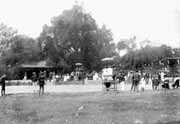
EARLY OJAI
TENNIS TOURNAMENT attracted players and spectators from all over California
- 1900
|
|
THE TRADITIONAL
ORANGE JUICE stand, a welcome sight for many tennis players during the
tournament.
|
|
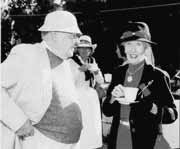
TWO FAVORITE
OJAI TENNIS Tournament supporters, Anson S. Thacher and Constance Wash,
enjoying a cup of tea from the famous Tea Tent.
|
|
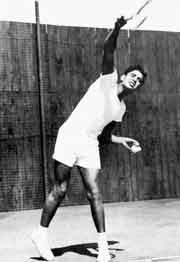
THE GREAT
PANCHO GONZALES, star of the 1949 Ojai Tennis Tournament.
|

|

