William
Thacher brought tennis to town
by David Mason
"The beautiful little Ojai Valley is the up to date spot of Ventura
County for out of door sports. Baseball and tennis has each flourished
like bull fights in Spain." - The Santa Paula Chronicle, 1899
In 1890, when William L. Thacher, a top-flight tennis player from Yale,
made his first trip to the Ojai Valley, it was for a three-week visit with
his brothers, who were living in the rural area. Upon his arrival, his
brother Sherman Thacher, founder of The Thacher School, said, "William,
if you have brought white tennis trousers and tennis shoes and a racquet
and white hat in your trunk, please, please keep them there. We here do
not play tennis at all. We work and play with horses."
Little did Sherman know that within a mere three years his brother
would change the way everyone was thinking. The local newspaper, The Ojai,
featured an article titled: "A Tennis Tournament for Doubles will begin
this week, open to all comers!" Sherman, along with one of the Thacher
teachers and six of the students were the only "all comers." Two of the
students, Rex Sherer and A.R. Williams, won the Ojai Doubles Championship.
These two Thacher students were the first valley tennis champions.
By 1895, the Ojai Athletic Club was organized with Sherman Thacher
as the first president. By June, the paper was reporting: "The ladies will
also be allowed the use of the tennis court and are invited to assist in
the finances by paying dues of perhaps ten cents per month."
On December 14, 1895, the Athletic Club held a special meeting of the
ladies and gentlemen who were interested in tennis, to form a tennis club.
It was decided to open the membership in the new tennis club to local residents
and to charge a 25 cents initiation fee and a three-month dues of 25 cents.
The club was anxious to increase its membership with people who were interested
in the game of tennis. To join, one only had to turn their name in to one
of the club officers.
William Thacher was elected as the first president of the Ojai Valley
Tennis Club.
On Feb. 15, 1896, the Ojai players met the Ventura players in the first
match - Ojai won. The matches were being played on the old dirt court,
which was located slightly to the east of the present courts, in Libbey
Park. The courts had been built on the back section of the old Blumberg
Hotel that stood in the downtown block. The tennis court was available
for use by the members daily, and there were special matches held on Saturdays.
The Ojai reported that: "The pleasure of the game was greatly increased
by erecting at each end of the court a wire netting backstop six feet high
and sixty feet long."
In 1897, the Ojai players and the Ventura players challenged the Santa
Barbara tennis team and the Ojai/Ventura team won. With that, another team
was formed, composed of members from all three sections - Ojai, Ventura
and Santa Barbara - and they promptly defeated the Los Angeles and Pasadena
players.
In 1898, they joined forces in a Southern California Champions team
and they played the Northern California Champions. The team from the north
defeated the one from the south.
The Ventura Free Press took notice and reported: "Rumor has it that
a lawn tennis club has been organized somewhere in the Ojai Valley; perhaps
The Ojai will tell us about it." With that, The Ojai reported: "There is
a tennis club up here. It has the best courts in the state. On them have
been held the greatest tournaments ever held in the state. The Ojai Tennis
Club has beaten the Ventura Club nearly every time a contest has been held.
The contests have been of frequent occurrence." The rest of the state was
also starting to take notice.
The Ojai continued to inform the Ventura paper: "As the Free Press
editors have not yet learned to distinguish any difference between a point,
a game, a set, a match, and a tournament, there is little hope that if
the Ojai should on the occasion of the next tournament defeat Ventura 9-0
matches, or a love tournament they would record the defeat to have been
by more than one point, or one racquet, or one tennis net."
At the 1899 tournament, three events were staged - men's singles, boys
interscholastic singles and doubles - and Ojai won the silver cup over
Ventura. The Ojai Tennis Club boasted: "We are being very generous in giving
Ventura a chance at that cup. This year the Ojai has won a match from Ventura,
and Ventura has won one from us." So confident was the Ojai team of winning
that they did not even carry the cup down to Ventura for the game, they
left it at home.
The Ventura Signal newspaper, decided to join the discussion by reporting
that Ventura was training a man to defeat the Ojai tennis champion, and
that the man was "laying for him." The Ojai responded with: "How very much
like a hen! The hen that refuses to lay should be interred in a pot-pie,
and we should be pleased to attend the obsequies."
With the popularity of the 1899 Ojai Tennis tournament, Wright and
Ditson sent the "The New Foot-Fault Rule" to the Ojai Tennis Club. It was
printed in the local paper for everyone's information; "By a vote of the
Executive Committee, Law 6 shall read as follows: The server shall stand
with both feet behind, i.e., farther from the net than the base line. It
is not a fault if one of the server's feet does not touch the ground at
the moment at which the service is delivered. He shall place both feet
firmly on the ground immediately before serving, and shall not take a running
or walking start. He shall deliver the service from the right and left
courts alternately, beginning from the right." (June 15, 1899).
In 1900, men's doubles, women's singles and mixed doubles were added
to the tournament. With the tournament's fame, the Tennis Club decided
to construct four new courts. The club reported that: "The new feature
this year will be the open events for all comers from any part of the country.
It is hoped that ladies and gentlemen who excel at the game in Ventura,
Santa Barbara, Los Angeles and vicinity may wish to compare their games
in these tournaments for all. Perhaps also some Eastern tennis expert may
be induced to enter if he chances to be wintering in California."
In 1907, invitation girls' interscholastic singles and doubles were
started, and in 1911, men's intercollegiate was added.
By 1916, front page headlines were: "Tennis Tournament Closes in Presence
of Record Throng" - the paper also counted the cars, and stated that: "
at 3 o'clock Saturday afternoon, the writer counted, including Fords, 157
automobiles parked from the corner to the tennis grounds - the greatest
number of machines in the valley at any one time, within the memory of
man."
The reporter continued: "Our early education having been sadly neglected
in the educational realm of tennis, we are not qualified to estimate the
true merit of the tourney along athletic lines, but those who do know the
play and the players, assert that it was GREAT - equal to the best tennis
played anywhere throughout the world, there being national champions and
ex-champions, and will-be champions behind the nets in the several events."
Edward Libbey, Ojai's greatest benefactor, was very much enchanted
by the whole tennis spectacle of so many young people having such a good
time and in such a good way, with their school flags flying and their obvious
desire to be sportsmanlike first and champions second. It appeared that
the presence of this event contributed somewhat to his keen appreciation
of the beauty of the valley as a whole. In any case, he bought the property
where the games were being held, tore down the old Blumberg Hotel and gave
the land to the town to be used as a park. Libbey wanted to put in cement
courts, but the officers of the Tennis Club thought that he had already
been very generous and should not have to do this. The courts remained
dirt until 1925.
By 1923, the Los Angeles Times reported that: "The Tournament is regarded
as one of the finest in the history of the Valley and was splendidly conducted
throughout." The local paper reported: "There is a recognized difference
in the measure of interest and enthusiasm touching tennis contests, home
talent capturing the lion's share in so far as this community is concerned,
while general interest hovers around the 'Champs' of other years." The
tournament was now well established in the importance of tennis.
But, the following year, 1924, the tournament was canceled. The tennis
club voted to abandon the holding of the Tennis Tournament that year on
account of the seriousness of the hoof-and-mouth disease among the cattle
of the state, in order to assist in the quarantine rules and regulations
put into force.
Some of the club members argued that other events were continuing to
be held, such as Easter Sunrise services, track meets, baseball and auto
meets, but William Thacher, president of the club, desired to cooperate
with the quarantine officers and the stockmen who had asked that Ojai give
up the tournament for that year. The motion passed and a letter was sent
to all entrants who had sent in their applications in advance.
In regard to the canceled tournament, the local paper said: "It does
seem strange that the Ojai Valley should be urged to cancel as promising
a Tournament as was in prospect when every other place in the country is
going ahead with their various tournaments. Los Angeles is making no pretensions
to give up any of her plays, and in a local paper there were announcements
of several large events in Los Angeles for the coming week." The next year,
the tournament resumed.
Now as we celebrate the 100th anniversary of the Ojai Tennis Tournament,
our thoughts return to the gentleman, William Thacher, who started the
tradition. Throughout the last 100 years, the Thacher family has continued
to be involved in the tournament, ensuring a successful event, one of which
the whole valley is extremely proud, and with a great deal of appreciation,
we say, "Thank you."
© 2000 The Ojai Valley News
Back
to the news |
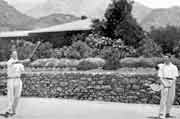
| THE
OJAI TENNIS TOURNAMENT doubles team from Thacher School - 1909. |
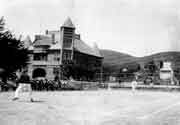
| THE
OJAI TENNIS TEAM and the Ventura team play in a three event tournament
on the Ventura team's courts - 1899. |

|

