Sherman
Day Thacher's legacy included The Thacher School
by David Mason
"The buildings are twenty-four in number, including school house, laboratory,
museum, 'rough house,' infirmary, dormitory, dwellings, shops and barns.
The land comprises about 200 acres. Eighteen acres are in orange orchard.
There are six tennis courts, four baseball fields, a Gymkhana track, the
rest being in pastures, canyons and hillsides. The boys have about ten
'shacks' in the canyons where they spend an occasional Saturday night."
- The Ojai, 1919
During the 1870s and '80s, ranches in the East End of the Ojai Valley
began to experiment with citrus and during the same time, a small private
boys' school was being started by Sherman Day Thacher. The Pierpont family
even opened a small hotel on their property to accommodate the parents
of Thacher's students.
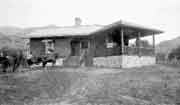
When Sherman married Eliza Blake in 1896, he built a new home for his
bride. The house was constructed on the school grounds, using plans that
were drawn by his brother Edward Thacher.
Edward had studied architecture at Yale University and L'Ecole des
Beaux Arts in Paris. He had worked for a short time as an architect before
giving it up and coming to the Ojai Valley to manage a local orange ranch.
The house he designed was built to take advantage of the breezes, with
the porch styled after the Japanese theory of openness. Almost every room
had an outside door. Six children grew up there, so several additions were
added during the early years. The interior includes a double brick fireplace
and built-in bookcases. The building was completed in 1896.
Edward had designed the school dining room building in 1895, with help
from the famous Santa Barbara architect Samuel Ilsley. Ilsley had just
finished designing a small hotel for the San Ysidro Ranch in Montecito
and, after helping Edward with the school dining room, Ilsley left Santa
Barbara and moved to Chicago to write plays. Later he returned to Santa
Barbara, and it was Ilsley's Filipino servant who introduced the yo-yo
to this country.
The Thacher School dining room is a large, irregular, two-story structure
with a hip roof. The windows are multipaned, double-hung and arranged in
rows across both floors. Above the main floor is a decorative pressed-wood
frieze in a ribbon design. The rafters are exposed under the eaves and
the siding is board and batten.
The building functions as both dining room-kitchen and administrative
offices. The original stone fireplace was built of rock that was hauled
from the end of Gridley Road. Originally, the building served as the parlor
and dining room-kitchen with the upstairs used as the school dormitory,
library and nurse's office. Wings have been added and a pergola connects
the building to the auditorium.
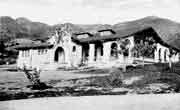
The admissions office was completed in 1911 and it was built as the
main building at the school. The building has a mission facade with bell
tower and entry arcade. The gable roof extends over the building with its
exposed beams underneath. A recessed walkway on one side of the building
is supported by arched columns. The interior of the building has an impressive
brick fireplace and the ceilings are open beam.
The building was designed by Arthur Benton, a Los Angeles architect
who specialized in the mission style. Benton had designed numerous villas
in the Montecito hills, the All Saints by the Sea Episcopal Church in Montecito,
and the charming Mission Inn in Riverside.
A second building at the school designed by Benton is the upper school
dormitory. This building, though built the same year as the admissions
office, is completely different in design.
The upper school dormitory is three stories tall and shingled, with
two prominent gabled wings that extend from the main section to create
a center entrance. Above the entry is a recessed balcony and topping the
balcony is a mission revival parapet with the date 1911; below it is a
classical frieze. The characters in the frieze are on horseback, and were
apparently favorites of Sherman Thacher; he had been very fond of Greek
mythology and horseback riding was also a major sport at the school.
Another attractive building was the Thacher library, built in 1928
and designed by the well-known architect Carleton Winslow, master of the
Spanish colonial revival style. The library building was designed to blend
with the mission revival style building built next to it, and an arcade
was built connecting the two buildings.
The library building is stucco with a tile roof. The main feature is
the large, arched, leaded-glass windows on both the front and side. The
front gabled parapet has a small rose window with the large arched window
below, flanked by decorative relief panels.
At the same time, Winslow was designing a new public library for downtown
Ojai. Winslow had made a name for himself by designing libraries and churches
throughout Southern California. Among them were St. Paul's Cathedral in
downtown Los Angeles, St. Mark's Episcopal Church in Del Mar, Mary Star
of the Sea in La Jolla, and the First Congregational Church in Santa Barbara.
The most striking of all of Winslow's churches is the Ojai Presbyterian
Church.
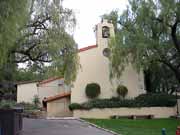
The Thacher chapel was originally known as the Hughes laboratory. The
money for the building's construction was a gift from millionaire Howard
Hughes, who had been a Thacher School student at one time.
The Hughes laboratory building was designed by Austen Pierpont, a self-taught
architect who had an excellent reputation throughout the Ojai Valley and
Southern California. He designed in the popular styles of the period, ranging
from the English Tudor and cottage styles of the late teens and '20s through
the Spanish colonial style and into the modern period of stucco and glass
of the 1940s and 1950s.
The laboratory was built in 1936 in the mission style with an arched
opening that included a bell. A recessed circular window was directly below
the bell. Stone steps and mission tile on the patio connected the neighboring
classrooms and library to the building and, by doing so, it created a unified
architectural theme with the mission and Spanish colonial revival styles.
In 1965, the western portion was converted into a chapel.
In 1937, Pierpont designed and built the middle school dormitory. The
long, irregular-shaped, two-story building is stucco on the lower half
and board-and-batten siding on the upper half. Outside stairways and arched
corridors lead to the room entrances. The second story balconies have a
wide overhang. A stone foundation and low retaining walls surround portions
of the building, which is then shaded by mature eucalyptus trees to add
just the right amount of character.
The Thacher Road home of Alvord Dodge was moved to the Thacher campus
in 1946. The two-story Craftsman-style house was designed by the prominent
Pasadena architect Myron Hunt in 1906. Hunt had gained a reputation for
outstanding buildings around Southern California, including the Edward
Libbey house in Ojai. Hunt designed all of the buildings for Occidental
College and had been part of the group that designed the "Millionaires
Colony," now known as Palos Verdes. Hunt would add to his reputation by
designing the Huntington Library in San Marino.
The Dodge house was moved to the Thacher campus for use as a dormitory,
due to the lack of building material for new housing during World War II.
In 1953, the main section of the home of Sherman and Eliza Thacher was
moved off of the campus and onto the Thacher Road property that was left
vacant after the Dodge house was moved to the school campus.
These are just a few of the outstanding buildings that have helped
to reflect the quality of life that the Thacher students have been enjoying
for more than 100 years.
"Thus have the charms of the Ojai Valley and the surrounding mountains,
the strength-giving climate of Southern California, and the standards of
scholarship and character always insisted on, developed a unique school
that draws boys from all parts of the country and sends them back to their
homes better and stronger men, ready to render the service of good citizens."
- The Ojai, 1919
© 2000 The Ojai Valley News
Back
to the news |
|
THE 1911
ADMISSIONS OFFICE built in the mission style by Arthur Benton.
|
|
THE NEW
THACHER SCHOOL, home of Sherman Day Thacher and Eliza Blake Thacher, in
the buggy. - 1896
|
|
HUGHES LABORATORY
at Thacher School was built in 1936.
|

|

