Thacher
family's arrival brought a tennis tourney and school
by David Mason
"Nordhoff is a world by itself in which it would
be almost a sin to labor and a crime not to commune with nature in her
ethereal beauty. Nor do the people violate these commandments, although
they raise a large amount of fruit and pursue some industry among their
beautiful surroundings."
- The Ojai, January 1899
The small valley was attracting a lot of attention before the turn of
the century. By 1872, F.S.S. Buckman had planted the first citrus trees
on a large parcel of land that he owned in the East End of the valley.
Buckman had found a way to bring water down from Horn Canyon to his
property, and with the hard work of clearing all of the wild brush and
carrying away the rocks by hand, he was finally able to plant an orange
grove on his cleared land.
When Edward Thacher arrived in the Ojai Valley, he came in search of
the finest oranges being grown in the state of California. His search ended
when he tasted the Buckman-grown citrus. He purchased the ranch and built
a small home on the property.
Edward was the son of Thomas A. Thacher, professor of Latin at Yale
University, and Elizabeth Day Thacher, daughter of the president of Yale.
Edward's mother bore five sons, but did not live long after the birth of
the last one. Thomas Thacher then married Elizabeth Sherman, and three
more boys and one girl were added to the family.
Sherman Day Thacher was the oldest child of this second marriage, and
at the age of 17, he enrolled in the Yale Law School. The following year
he went to Kansas City to practice law. Soon he was joined by his close
friend Horace Taft, the brother of William Howard Taft, America's 27th
president. The law firm was not a success and soon the two men returned
to their homes.
Sherman's brother George, the youngest of the Thacher boys, had a bad
heart condition which was brought on by a case of scarlet fever as a child.
In 1887, he was 17 years old and was not given long to live. It was decided
that a mild climate might prolong his life, and with Sherman being out
of a job and getting rather depressed, he brought George to California
and they stayed with their half-brother Edward.
The brothers came to California by way of the Isthmus of Panama. What
they found when they arrived in the Ojai Valley were peaceful surroundings,
extreme heat and dry hills. It, however, suited them well; they adapted
to the carefree ranch life and were very happy.
George's health continued to fail and this brought his mother to the
valley to help care for him. George died in January of 1889. The first
library in the small town of Nordhoff, now Ojai, was named the George Thacher
Memorial Library in honor of this young man.
Sherman decided that he would stay in the little valley, and he took
up a claim on a piece of government land that was about a mile north of
his brother Edward's ranch. The first job for Sherman to undertake was
the building of a small three-room house on his newly acquired property.
In June of 1889, Sherman received a letter from an old friend of the
family, Professor Henry W. Farnam from Yale. In the letter, he asked if
his nephew Henry Farnam would come and live with Sherman and be tutored
for his entrance into Yale. This was acceptable, as Sherman and all of
his brothers except George, had for years gained extra money by tutoring
students when they had lived in the East. Sherman agreed to let Henry come,
and Professor Farnam and Henry arrived in August of 1889 to look over the
place and make the arrangements.
It didn't take long before the word had spread around the whole country
that Sherman Thacher would tutor, and an ambitious 14-year-old from Ventura
asked if he could join Henry. The second student Rex Sherer had almost
no money, but he was willing to milk the cow and do odd jobs around the
place to pay for his tutoring.
The second year, Sherman tutored five boys, and since he realized that
the oranges were not going to do much to help him financially, he decided
that teaching boys would supply him with a steadier income.
Sherman advertised his small learning institute in national magazines
and the response was gratifying; the school opened with 11 boys. Edward
Thacher was also able to spend some time teaching at the school, and Sherman's
mother helped with the boys' manners.
William Thacher, one of Sherman's brothers, arrived in the valley in
1895 to join the school faculty. William had been a top-flight tennis player
at Yale, and he became the founder of the Ojai Valley Tennis Tournament.
He arrived only a few months before the school suffered its worst disaster.
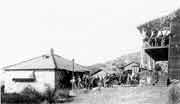
Early in the morning of June 18, 1895, a fire broke out in one of the
buildings at the school and, due to little water pressure, it quickly spread.
All of the buildings, except the barn and the stone houses, were completely
consumed. All of the people living at the school were unharmed and they
moved into the hotel at the Pierpont Cottages.
Sherman was faced with the decision - should he abandon the school
idea and return to the East, or should he try to rebuild the boarding school?
Since he had recently met Miss Eliza Blake and had fallen in love,
Sherman was influenced by her to borrow money and rebuild the school.
The first buildings to be rebuilt were the dormitory and the school
room and offices, which later became the Middle School dormitory and the
main building with parlor, dining room and kitchen downstairs and upstairs
room for the Lower School boys.
To decorate the dining room, Sherman hung flags of every country around
the walls and the American flag over the door. Besides the flags, the room
was also decorated by Japanese lanterns hanging from the ceiling. The heat
was provided by a large wood-burning stove and the lighting was by kerosene
lamps.
In the summer of 1896, Sherman married Eliza and built a lovely home
for his new bride at the school.
The school had many unique features. Calisthenics came about 10 a.m.,
after classes had been held for an hour and a half. At recess, everybody
played baseball, followed by a gathering outside the kitchen for soup and
crackers.
The students were allowed to come to the dining room at breakfast and
lunch in blue jeans or khakis, but they had to wear a coat and have a bandanna
tied around their neck. The coats and bandannas hung on hooks outside the
dining room door to be snatched up and put on before they entered the room.
At breakfast, the boys would be excused from the table individually
as each finished eating. At the other two meals, everyone in the dining
room arose at the same time to be dismissed by the headmaster.
For the evening meal, the boys were required to dress in suits, white
shirts and ties, hair brushed neatly and shoes polished. Dinner was prepared
on a wood-burning stove by the Chinese cooks.
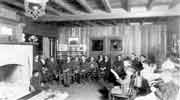
In the evening after supper, everyone gathered in the school parlor
and Sherman read aloud for about 40 minutes. The boys then went off to
study hour. When it was time for the youngest ones to go to bed, they had
to come down, go through the parlor and shake hands and say good night
to whoever was there. A half-hour later, the Middle School boys would come
through the parlor and say good night - and then the Upper School boys
would do the same.
As the student body increased, the school expanded. The Thacher School
reputation was spreading across America.
"The great experience for a boy comes from the ownership of his horse
(each boy must own one and take full care of it), and from the camping
trips into the neighboring mountains and valley, over the trails of the
forest reserve in which the school is situated. Each boy learns something
of what the wilds have to teach. He must know how to play his part as a
good camper; to take care of his horse on the trail and in camp; to make
a proper fire; cook, wash up and leave camp and fire clean and safe, and
to be a good fellow at all times."
- The Ojai, 1919 (to be continued)
© 2000 The Ojai Valley News
Back
to the news |
|
THE THACHER
SCHOOL prior to the devastating fire of 1895.
|
|
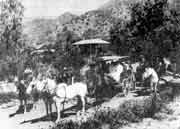
THACHER
STUDENTS, teachers and family members leave for church in the town of Nordhoff,
now Ojai - 1900.
|
|
MR. THACHER
READ as Eliza and Madame Thacher and students listened. Reading light was
from kerosene lamps in the ceiling and on the table.
|

|

