John Philip
Sousa's visit made an impact on Ojai
by David Mason
"Sousa has said that he was ready to give his audience three-fourths
of an hour more of concert, but that the applause was not tumultuous enough
to induce the extra wind-jamming."
- The Ojai, March 18, 1899
Sousa's arrival in the seaside town of Ventura caused a mild epidemic
of excitement in the Ojai Valley.
The tour was the fourth grand transcontinental trip of the band and
concerts were given in 38 states. This tour was the final one before the
Sousa band would depart for Europe on its first foreign tour.
John Philip Sousa was born in Washington, D.C., on Nov. 6, 1854. His
father, Antonio, had played the trombone while in the U.S. Marine Band,
and so John Philip grew up around military band music. By the age of 6,
he was studying music. He loved all of the instruments, and took instructions
in violin, piano, flute, cornet, trombone and alto horn. He also studied
voice.
His father enlisted him in the Marines at the age of 13 as an apprentice
in the Marine Band, after he discovered that his son was attempting to
run away from home and join a circus band.
At the age of 18, John Philip Sousa published his first composition,
titled "Moonlight on the Potomac Waltzes."
By the time he was 21, he had been discharged from the Marines and
was off on his first musical tour, conducting theater orchestras. His musical
talent was recognized and the same year he was brought to Broadway to conduct
Gilbert & Sullivan's "H.M.S. Pinafore."
In 1880, Sousa gave up Broadway and returned to Washington to assume
leadership of the U.S. Marine Band. He served as band leader under presidents
Hayes, Garfield, Cleveland, Arthur and Harrison.
By 1892, Sousa was convinced to resign from the Marine Band and to
create his own civilian concert band. He originally named the band Sousa's
New Marine Band, but criticism from Washington, D.C., forced the withdrawal
of the name.
Returning from a European vacation in 1896, and during the ship's crossing,
Sousa received the inspiration for "The Stars and Stripes Forever." The
next trip abroad was to be a working tour, but before leaving, Sousa would
delight thousands of Americans across the United States.
Eighty Ojaians heard Sousa's band in Ventura on Monday, March 13, 1899.
Of these, 22 were from Thacher School. The railroad company ran a special
train to the Ojai Valley to ensure the Ojaians a safe trip.
A Thacher School student wrote a composition in regards to the trip
and concert. "On Monday afternoon, I, with most of The Thacher School,
drove down to the Nordhoff station in a large three-seated coach. We got
there a little early, and the boys played a sort of catch until we heard
the train whistling as it came slowly around the curve."
The train would depart the Nordhoff station as soon as all were aboard
for the trip the Ventura. The Thacher student's writing continued, "The
view from the window is beautiful as the train winds slowly around the
hills and through small forest of live oak trees. We arrive in Ventura,
and as soon as we are off the train (which is not long), walk four blocks
till we come to 'Armory Hall,' where the concert will take place. We got
in Ventura a little early and had time to look around the town."
The concert began at 2:30 in the afternoon, and when the curtain came
up, John Philip Sousa stepped out and struck up the overture.
Sousa promised the audience that he would continue to play as long
as they continued the applause. The large crowd was highly enthused and
applauded every selection until the encore, and the second encore and the
last encore. Sousa walked off the stage feeling as though his music was
not appreciated, even though when the "Star Spangled Banner" was played,
all of the people yelled, stamped their feet, clapped and stood and sang.
The crowd failed to see why Sousa felt that they did not enjoy his
performance, but since his band had just come from entertaining at a Texas
concert, they felt that he must have expected Venturans to demonstrate
their appreciation by shooting out the lights and breaking the windows
and smashing the furniture, such as what had just happened in the Lone
Star state.
The Ojai newspaper reported that, "The great conductor should be told
by somebody that when this country puts on its Sunday-go-to-meetin' duds
and travels miles to have its savage beast soothed, it does not feel called
upon to rend its clothes and raise a riot as a means of convincing the
music sharp that it thinks his music is the best thing of the sort ever
unboxed. But we do think so, and our applause was as vociferous as any
audience outside of Texas or a phalanx of army mules could give."
The Thacher boys enjoyed their afternoon and evening in the city of
Ventura. After the concert, some of the boys did shopping and some went
down to the beach. After a good supper at the Anacapa Hotel, they took
a Ventura bus to the train station and caught the train home. The Thacher
student finished his composition by writing, "I had a pleasant ride home,
both in the train and in the bus we sang songs and had a great time. When
we reached home there was crackers and milk served, and I am sure I went
to bed perfectly satisfied."
Not to be outdone by Sousa, the Ojai Band held its own tour. The band
may not have toured the nation, but it did make it to Port Hueneme. The
event was in honor of the 1899 Fourth of July, and the band entertained
two packed cars filled with Ojai people when the train pulled out of the
Nordhoff station early in the morning. The band played many tunes and the
people sang until the train reached Oxnard. The tour continued on to Hueneme
by bus where the band boys, after washing up, set the town swaying with
a rendition of the "Grand National March" and a few other tunes until 11
a.m. The Ojai Band then played another march, leading the crowd to a large
warehouse where the exercises of the day began. After more music by the
Ojai Band, about 100 school children, supporting the Goddess of Liberty,
sang "Red, White and Blue" before a reading of the Declaration of Independence.
At 1 p.m. the dancing began and the Ojai Band was there to play. They
had never played for a dance before, and aside from a discord or two, the
fellows all fell in with the spirit of the thing and decided to try their
hand at playing a waltz, which they played three times. Once the band boys
had gained confidence in their ability to play dance music, and they were
willing to tackle any kind of music and, in most cases, playing each tune
twice and polkas five times. Keeping perfect time, the band sent the crowd
through the liveliest polka that was ever danced.
The newspaper reported that when the polka was over, " there wasn't
a dry stitch of clothing on any of 'em, and all had to take a rest. For
five minutes they stood gasping and wiping away the perspiration (and some
of them their complexions along with it), and then they came up smiling
for more Ojai Band dance music."
Hueneme people had spared no expense in making the town attractive
for their guests. There were between 3,500 and 4,000 people in the town
and all of them had a good time.
The newspaper complimented the band, " on the music, on the marching
and on the conduct of its members at all times; all the members assembled
promptly at whatever times and places were appointed; and our handsome
and efficient leader was kept blushing between tunes. The compliments that
fell upon his ears were very deliberate, but the blushes were entirely
extemporaneous."
To the town of Hueneme the band said, "You're it! Our fellows all say
so, and they are good judges. We enjoyed every minute of the time spent
with you and had a royal time. We all like you and think that you are first
rate."
John Philip Sousa was among the few that didn't attend the Ojai Band
concert, but over the next 33 years he made three European tours, a world
tour, and during World War I, he joined the U.S. Naval Reserve at the age
of 62 and was assigned the rank of lieutenant and was paid a salary of
$1 per month.
After the war, Sousa continued to tour with his band. He championed
the cause of music education and received several honorary degrees. He
also fought for composers' rights, testifying before Congress in 1927 and
1928. He died in 1932 during a rehearsal. The last piece of music he conducted
was "The Stars and Stripes Forever."
© 2000 The Ojai Valley News
Back
to the news |
|
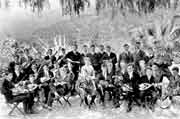
THE THACHER
SCHOOL BAND, inspired by the performance of John Philip Sousa.
|
|
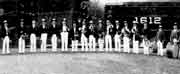
THE OJAI
BAND as it waits to board the first train to Ojai - 1898.
|
|
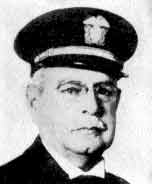
JOHN PHILIP
SOUSA, American bandmaster and composer, thrilled the Thacher students
in 1899.
|

|

