Williams
designed some of Ojai's largest estates
by David Mason
"Why do you want to be an architect - why don't you study to be a
doctor or a lawyer?" This was the first question the student advisor asked
me when I entered high school I think I told him that I had heard of only
one Negro architect in America and I was sure this country could use at
least one or two more." - Paul R. Williams, "If I Were Young" - Ebony,
August 1963
In 1914, at the age of 20, Paul R. Williams won honors for his design
of a town civic center, which would become the first in a long list of
prizes and awards the young man would receive. He was then given First
Honorable Mention in architecture at the Chicago Emancipation Celebration
in 1915 and the next year, he received third place for the Sperling Prize,
a countrywide competition held in New York. These awards only convinced
him that he had indeed chosen the right profession.
Paul Williams was a native son of Los Angeles, being born there in
1894. Williams' father and mother had come to California from Memphis and
had opened a fruit stand in the plaza, which was then the center of town.
Williams' talent at drawing caught the eye of a local builder and he was
encouraged to pursue an architectural career.
Entering Polytechnic High School, he enrolled in all of the architectural
classes. Years later he would recall his instructor's response when he
declared his intention to become an architect. "He stared at me with as
much astonishment as he would have had I proposed a rocket flight to Mars."
His instructor demanded, "Who ever heard of a Negro being an architect?"
He pointed out that people of Williams' race built neither fine homes nor
expensive business buildings and that he would therefore be obliged to
depend entirely upon white clients for his livelihood.
Williams could not be discouraged. With his passion for the designing
and sketching segment of the architectural field, he was even told by his
first employer, " he would never develop into a successful architect because
he was only interested in the artistic side of architecture." Taking the
advice from his employer, Williams enrolled in an engineering course at
the University of Southern California, but at the same time he attended
three different art schools: one in interior design, one in color harmony,
and one in the art of rendering.
With new determination, Williams set out to secure a position with
a local architectural firm. By the second week of his pursuit, he had received
three offers to work as an office boy, ranging from no pay to $3 a week.
He chose the non-paying job because it was with an important architectural
firm in the city and he recognized that the experience would be invaluable.
To his surprise, they broke their contract and paid him $3 a week.
Williams continued to enter architectural contests and won three consecutive
awards for his designs of small houses, which established him as a specialist
in the modest-sized dwellings. A classmate became aware of his residential
success, and hired him to design his new home. This commission inspired
Williams to open his own office, with the knowledge that he had a least
one client.
In 1922, Williams opened his first office in the Stock Exchange Building
in downtown Los Angeles. His former employer handed him a $90,000 residential
job with the advice, "Let this be a starter for your new office."
The years of 1926 and '27 would find the young architect working on
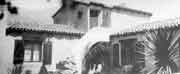
his first commission in the beautiful Ojai Valley. The house was a striking
Spanish-stucco design being constructed on the road leading to the beautiful
and popular Foothills Hotel. J.S. Riley of Los Angeles, a member of the
firm of Drake, Riley and Thomas, had been so impressed by the buildings
that Williams designed, that it was only natural for the Rileys to use
this young man for their new Ojai home.
The Riley house was a combination of single-story and two-story with
the traditional outside staircase leading to the second floor. The heavy
tile roof blended well with the Spanish style that was becoming characteristic
of the buildings being built in the Ojai Valley. The house was constructed
at a cost of $20,000 by the leading contractor in the valley, Sam Hudiburg.
By 1929, Williams had become so successful that he was hired by E.L.
Cord, the auto magnate to design a 32,000-square-foot showplace in Beverly
Hills. During his career, Williams would design more than 300 houses for
the Beverly Hills area. In the early '30s, Williams had become known as
one of the city's leading residential architects.
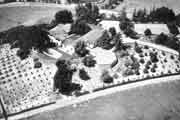
Mr. William Ford, of the Libbey-Owens-Ford Glass Company, chose Williams
for the architect of his Ojai Valley home. The Ford house was constructed
in 1929, with a special feature, a loggia that looked through the arched
doorways to the grand courtyard that the house surrounded. The oversized
living room, the central point of the main rooms, would accommodate the
largest of parties. The 14,000-square-foot house was one of the first to
be built in the Country Club Estates, a subdivision created by John Burnham
who also owned the Rancho Matilija.
Williams was careful to consider the lifestyle of the family in order
to create something that would be individual and not duplicated by any
other structure.
Williams' outstanding reputation brought him to the Ojai Valley again
in 1929. This time to design the sprawling ranch house and stables for
Irving Augur of Pasadena. Augur was born in Iowa in 1887 and had come to
California as a young man. He had graduated from the University of California
where he was a member of Phi Kappa Sigma fraternity and was prominent in
athletics.
After graduating from college in 1911, he studied the oil producing
industry by working in many branches and after this apprenticeship he served
as the deputy state oil and gas inspector. In 1921 he was one of the organizers
of the Bolsa Chica Oil Corporation.
The Leach family had sold Augur 200 of the 400 acres of their Ojai
ranch. The land was along the Dennison Grade Road and, while some of it
was on the hillside, there was also much tillable property, which was planted
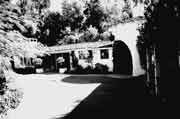
with citrus. As the ranch matured, a small section of the property was
leveled for the construction of a rambling stable and caretaker's quarters.
The main house was on a hillock entirely screened from the road on
every side by luxuriant oaks, so that no view of the home could be had
from any of the roads, including the Grade Road as it wound up the hillside.
Williams' use of a small round tower to connect the stable to the help's
housing set the theme of the ranch. Small towers accented the grounds and
it was the basis for the name "Round Tower," given to the ranch many years
later.
The Ojai newspaper said it regarded the Augur property as, "One of
the most important and beautiful improvements to be undertaken in the valley."
Williams' perfectionism showed in his attention to the smallest detail
in his house plans. His staff was not immune to his perfectionism either;
they were dismissed for improper dress, or for speaking in an inappropriate
manner.
Williams enjoyed the advantages of a career that afforded him a close
association with giants of industry, prominent politicians, and some of
the most exciting people in the entertainment industry. He designed the
homes of Lon Chaney, both in Beverly Hills and in Lake Arrowhead - also
the homes of Corinne Griffith and Bert Lahr in Beverly Hills; Virginia
Bruce and Anthony Quinn in Pacific Palisades; ZaSu Pitts; Jennifer Jones
and Tyrone Power in Brentwood; Barbara Stanwyck in Northridge; Julie London
in Encino; Frank Sinatra in Trousdale Estates; and Zsa Zsa Gabor's beautiful
residence in Bel Air. Williams also designed the homes of William "Bojangles"
Robinson and Eddie "Rochester" Anderson in Los Angeles.
The striking Al Jolson Memorial Shrine, that domineers Hillside Memorial
Park in Culver City and the awe-inspiring Pearl Harbor Memorial in Honolulu,
Hawaii, are both works of art by Williams.
Commercial buildings received the same attention as the residential
commissions. Williams designed the General Hospital in Los Angeles, the
Knickerbocker Hotel in Hollywood, Arrowhead Springs Hotel, Chasen's and
Perino's. His artistic touches to the Beverly Hills Hotel, including the
Polo Lounge, and to the Beverly Wilshire Hotel are the most visible. The
Ambassador Hotel in Los Angeles also received his attention.
Out-of-town commissions were equally successful, including the Palm
Springs home of Lucy and Desi Arnaz, the Palm Springs Tennis Club and the
Spring's El Mirador Hotel and Cottages. He also designed the Golden Pheasant
Restaurant in San Francisco, the additions to the Flamingo Hotel and Casino
in Las Vegas, the Jai Alai Fronton in San Juan, Puerto Rico, St. Jude's
Hospital in Memphis and the Howard University in Washington D.C.
With his partners, Williams also designed the space-age theme building,
with its hovering space capsule restaurant, for the Los Angeles International
Airport. From churches to mortuaries, youth centers to financial institutions,
Williams believed that the visibility of his designs in the community where
he lived and socialized was immensely important.
"My definition for progress is that you do something better today than
the way you did it yesterday, and plan to do it even better tomorrow."
Paul R. Williams, The Scottish Rite Informer, January 1957.
© 2000 The Ojai Valley News
Back
to the news |
|
THE COUNTRY
CLUB ESTATES home of William Ford, designed by Paul Williams in 1929.
|
|
THE SPANISH-
STYLE HOME of the James S. Riley family, shortly after construction was
completed in 1927.
|
|
THE SPRAWLING
HORSE stables and caretaker quarters of the Irving Augur estate, bordered
by the Dennison Grade Road, an Ojai Landmark from the time it was constructed
in 1929.
|
|
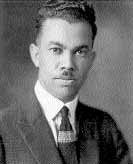
PAUL R.
WILLIAMS added his touch to the Ojai Valley.
|

|

