William
Randolph Hearst was among early visitors at famed golf course
by David Mason
"Much has been said and written of the Ojai course and yet half of the
story cannot be told. Nature built the course and George Thomas and Billy
Bell were satisfied to let Nature's work stand. Only here and there have
traps been built and in every case these traps are made to conform to the
general contour of the land. There is little artificiality at Ojai."
- Los Angeles Examiner, 1925
In the first quarter of the last century, the thought of a world-renowned
country club for the Ojai Valley only seemed like a dream to most of the
people.
By 1923 the dream was about to become a realization, and a popular
sport was being added to the valley that would bring fame and favor of
"The Ojai" to the world of athletics. This was being made possible by Ojai's
greatest benefactor, Edward D. Libbey.
In May of 1923, 200 acres of brush and rock-covered land was purchased
by Libbey for the construction of one of Southern California's finest golf
courses and clubhouse.
Many of the residents of the valley knew very little about the game
of golf, even though the valley had already supported two other golf courses.
The people knew that the game was not a backyard or even an acre-lot sport,
but required a generous fraction of a province, a state, a county or a
township, and that the name "Country Club" was suggestive of something
greater and grander than a city lot.
Libbey had been contemplating a golf course in the Ojai Valley for
some time, and after his first conference with the famous landscape architect
from Los Angeles, George Thomas Jr., both men were extremely enthusiastic
and plans were drawn up at once for the new links.
The Los Angeles newspapers, in reporting on this planned improvement
to the valley by Libbey, said: "The ground is timbered with oak and sycamore
trees and the contour of the land provides natural drainage that will do
much to simplify the work of the construction engineer who will build the
links. The soil is a sandy loam and is admirably suited to the growing
of turf.
"One feature of the course will be the natural water hazards, taking
advantage of the bends in the creek that runs through the land. These hazards
will be unique in Southern California, as most such hazards are artificial
in character and appearance.
"With the opening of such a golf course and with the many tennis courts
Ojai now has, there is every reason to believe that the valley's popularity
will increase almost unbelievably as an all-year resort."
Driving down the highway and looking over the rough and rugged land
that was being whipped into the most ideal golf course in all of California,
the scenic beauty was lost. But on the knoll where an imposing clubhouse
was being built, you could cast your eyes to about any point of the compass
and nature's rich gifts of hill, canyon, valley and forest were spread
out before you in a wonderful way.
The clubhouse occupied ground space of 130 by 60 feet. There were no
guest sleeping rooms, but a large kitchen and dining room were built so
that parties could be held at the club. The caretaker quarters occupied
the small second floor of the building.
The Southern California Chapter of the American Institute of Architects,
in presenting their top honors to the country club, said: "One of the most
interesting examples of typical California architecture for 1923 is the
Ojai Valley Country Clubhouse. Wallace Neff, Pasadena architect, designer
of these structures, was recently honored by California architects for
this work. The club is one of the most interesting modern Spanish architectural
creations in California. It is a low, rambling hacienda-type structure,
with red-tiled roof and flagstone terraces. In this piece of work, Mr.
Neff is said to have realized the successful adaptation of his architectural
scheme to the environment, the building being perfectly harmonized with
its surroundings."
The clubhouse, coupled with the golf course, was ideal in its natural
topography and grandeur, and nowhere was it outclassed in all of California
for a round of 18 holes, with scattering obstacles, natural and acquired,
and welcomed by experts in the game of golf. The Ojai newspaper reported
that: "More tourists will come; more winter homes will be erected, and
hotel patronage will grow by leaps and bounds."
The opening was held Feb. 15, 1924. The Ojai newspaper gave the event
coverage on the front page: "Today marks the beginning of a new epoch in
the social and athletic life of the Ojai Valley." The club opened with
a full staff and the first nine holes were ready to receive the players.
Libbey issued a formal invitation to the people of Ojai, Ventura County
and all of Southern California to come and enjoy the links free until the
official opening, which would be held in a month and a half, when all 18
holes would be completed.
Everyone who was privileged to participate felt that the whole event
was in the nature of a social function, presided over by Libbey and his
wife, who entertained the guests and served an elaborate dinner in the
new clubhouse in faultless style.
The interior of the clubhouse had rich furnishings in fetching colors
of orange and blue. The colors, harmonizing with the general scheme of
architecture, Spanish in character, presented an attractive appearance
that was appreciated by all of the guests.
The visitors were enthusiastic in their expressions of admiration in
the matter of location and the excellence of the golf course, which was
tried out by a large number of players during the day.
From opening day, the new country club would attract important people
and their visits would become front page news for the local newspaper,
The Ojai.
One of the first visitors was Mrs. Carnegie, widow of Andrew Carnegie,
steel magnate and the nation's greatest benefactor in public gifts. Mrs.
Carnegie and her sister were on their way to Pasadena before leaving for
the East Coast by way of the Panama Canal, when the Libbey's invited them
to the club as their guests.
Early visitors also included Editor and Mrs. William Randolph
Hearst, who formed a motoring party from Los Angeles and drove around the
valley before going to the club. The Hearst party was delighted with the
valley's beauty and greatly taken with the clubhouse and the charming view
it afforded of the golf course. (Thankfully, Libbey had already developed
this site, otherwise we might have had a castle perched on that knoll.)
The Los Angeles Examiner wrote glowing reports of the new country club
and golf course: "Here is a magnificent course laid out in picturesque
rolling hills far from the center of civilization. Here is an artistic
clubhouse overlooking the entire valley, with locker rooms and grill accommodation
to take care of a hundred players. Most important of all here is a club
without the faintest touch of promotion or commercialism.
"The course is finished, the clubhouse is completed and yet there has
been no 'drive' for members, no insistent demand that the public invest
in this project of Mr. Libbey's. Such an attitude is refreshing and at
the same time intrigues the interest of all golfers."
The Los Angeles reporter continued: "The day was one of surprises.
Rugged mountains form a great amphitheater about the town of Nordhoff,
which now bears the name of Ojai, and the golf course and clubhouse are
on the rolling hills that overlook the town proper. The clubhouse is perhaps
a quarter of a mile off the boulevard and is the same distance from the
center of town. The golf course surrounds the club and runs down to the
boulevard, right to the edge of the town's main street."
The Examiner raved that the course, clubhouse and the entire layout
were a work of art. The designer could not be blamed for being a bit proud
of his work.
Everyone was interested in seeing the new club. A Navy lieutenant from
San Diego flew a military plane up to the country club to check out the
golf course. He made a bad landing on the course and ran the nose of the
plane into one of the sand traps and broke his landing gear and propeller.
After a few days, the damage was repaired, but in leaving the golf course,
he struck the high tension power lines along the road and crashed again,
landing right side up by pure chance, and once more he damaged the landing
gear and one of the struts. Repairs were again brought up from San Diego
and the lieutenant was finally able to return to his base.
Libbey built the course and clubhouse because he felt the valley needed
it and because he loved to be surrounded by the type of sportsmen such
a club was certain to attract. Ojai had become one of the most notable
tennis centers of the world, and with such a golf course, there was no
reason to believe that it was only a question of time until it would be
represented by golfers capable of competing for the nation's highest golf
honors.
With the success of the Ojai Valley Country Club, Libbey had Wallace
Neff design a large sprawling hotel to be built alongside of the clubhouse.
The hotel was also to be in the Spanish design and would have made a beautiful
addition to the club. However, this hotel was not to be, since before it
could be built Libbey, the great and good man to whom the Ojai Valley owed
so much, passed away at his home in Toledo, Ohio. The country club was
then purchased from the Libbey estate by a group of club members. The money
was raised through memberships and, since the club had an outstanding reputation,
interest in the club memberships was widespread - in a very short time,
the money was raised.
Libbey's contributions, along with the country club, will remain forever
enshrined in the heart of "The Ojai," chiefly because he gave the physical
embodiment of beauty which makes up the core of our valley. But for his
vision and liberality, the attractive and harmonious little town of which
we are so proud would never have come into existence.
© 2000 The Ojai Valley News
Back
to the news |
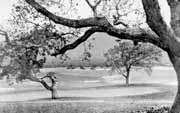
| THE
VIEW OF THE Ojai Valley across the golf links from the Ojai Valley Country
Clubhouse - 1924 |
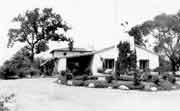
| THE
BEAUTIFUL WALLACE NEFF CLUBHOUSE for the Ojai Country Club - 1924 |
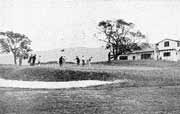
| PLAYING
THE FIRST NINE holes at the newly completed Ojai Country Club - 1924 |

|

