Neutra brought
a new style of architecture
by David Mason
"I shall never live with fewer worries, never have time to develop ideas.
I wish I could get out of Europe and get to an idyllic tropical island
where one does not have to fear the winter, where one does not have to
slave, but finds time to think and more importantly, to be a free spirit."
- Richard Neutra December 8, 1919
Richard Neutra, would not only surprise America with his exciting designs
in architecture, but he would find himself being the talk of a small town
in Southern California.
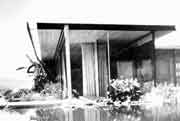
Commissioned by Mr. and Mrs. James Moore to design their unique Ojai
home, Neutra realized that the structure would indeed become one of the
most famous of all of his private dwellings.
This, however, was not the first house Neutra designed in Ojai. In
1943, Howard Bald had used the talented architect for his home in the East
End of the valley. Bald had arrived in Ojai in the spring of 1900. He was
8 years old, and ill with tuberculous. The doctors had recommended that
Bald be brought to Southern California for the mild climate. As an adult,
Bald would spend many years working for the Forest Service in the backcountry
of Ventura County.
Far from the valley, Neutra was born in Vienna in 1892, and before
coming to America, he had attended the Technische Hochschule in Vienna
and the University of Zurich. In 1923, he won an international award for
an architectural drawing that he had done and the prize enabled him to
travel to the United States. Upon his arrival in America, Neutra spent
a short time working with the famous architect Frank Lloyd Wright.
Neutra was well-influenced by Wright, with his ideas that the concept
of each house be of the open plan and extend beyond the boundaries of the
house itself, and into the surrounding landscape. This plan would eventually
be the important element that made Neutra famous.
In 1925, Neutra and his wife Dione settled in the golden state of California.
The state became much more dazzling as the striking homes, designed by
Neutra, began to appear on the lush hillsides.
Neutra's reputation did not become fully established until the Lovell
house in Griffith Park was completed in 1929. As the first steel-framed
house built in the international style in America, the Lovell house is
of unparalleled historical significance. It's also known as "Health House,"
derived from the fact that Neutra's client, Dr. Philip M. Lovell, who was
a fitness expert, wanted to build a house that would symbolize physical
well-being. To this end, he invited those interested in the project to
visit him as soon as the house was completed, and Neutra conducted the
tours, which resulted in more than 15,000 people being able to see and
admire it personally.
Before World War II, very few commissions for buildings had been awarded
to architects of the Modern Movement, although the Modernist aesthetics
had been deemed acceptable for functional buildings, such as factories.
After the war, this changed and one of the reasons was the psychological
desire to leave the past behind and to go on to things that were new. The
people were beginning to respond to the modern designs, having become tired
of buildings that appeared to be old-fashioned in style. By the 1950s,
all of America was wanting to look to the future.
Neutra's designs became less heroic and more serene than some of the
other Modernists of the period.
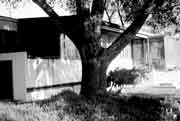
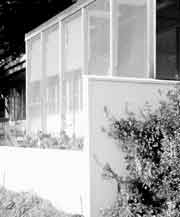
The Bald house was basically rectangular in shape, single story with
a flat roof. To take advantage of its sweeping view of the whole valley,
the west side of the house was built primarily of floor-to-ceiling glass
walls.
For the highly acclaimed Moore house in Ojai, Neutra integrated the
building within the landscape. The scale of the windows in which the house
was sheathed meant that during the daytime the landscape became an integral
living component of the interiors, and at night, throwing out its light,
the house acted like a beacon on the mountain side. Taking full advantage
of the serene beauty of the landscape in which it is situated. The low-lying
building did not attempt to compete with the visual power of the mountains,
but to exert a quiet aura and potency of its own.
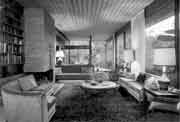
In this house, Neutra adopted an idea that he had successfully exploited
earlier - frameless mitered glass joints in the corners of rooms - to allow
the maximum amount of light to enter the house, and to provide a completely
uninterrupted view of the surrounding mountains. The distinction between
the interior and the exterior has been all but abolished by the use of
glass walls.
Neutra's buildings received considerable attention and media exposure
during the 1950s, both in America and abroad, and in the field of domestic
architecture, he was clearly the most celebrated and influential figure
of that time.
Today, these two outstanding examples of Richard Neutra's architectural
designs are an important part of the Ojai Valley. Neutra is but one of
the many contemporary architects who worked their magic in the valley.
The design period of the 1940s and '50s warrants closer attention and deserves
a greater respect.
Editor's note: With a busy florist holiday
approaching and summer on its way, David Mason plans to take a sabbatical
from his "Remembering When" column for the Ojai Valley News. The column
will return in fall.
© 2000 The Ojai Valley News
Back
to the news |
|
RICHARD
NEUTRA'S highly acclaimed James Moore house, overlooking the Ojai Valley
- 1952.
|
|
THE BEAUTIFUL
LIVING ROOM of the James Moore residence in Ojai - 1960.
|
|
THE BALD
HOUSE was an early example of the Modern Movement - 1943.
|
|
FOR HOWARD
BALD, Neutra took advantage of the view from the location and incorporated
a wall of glass for the living room - 1943.
|

|

