The Libbey
property is one of Ojai's great estates
by David Mason
"Mr. Libbey conceived the possibilities of a greater Ojai, and carried
out his ideas at no small cost, giving commercial momentum to stagnant
conditions, and creating a civic center, with suburban environments that
have no counterpart in California." - The Ojai, 1919
The view from the front door of the house on Foothill Road of the Ojai
Valley's greatest benefactor, Edward Drummond Libbey, was of the impressive
stone and iron gates that led into his Encina Park. The winding roads were
outlined with native rock, which had been placed there by the many workers
that Libbey had hired to clear the vast amount of land.
Next to the iron gates, Libbey had Robert Winfield build an entrance
lodge. Winfield had come to the Ojai Valley from San Diego to do the construction
of the many buildings that Libbey was having built. At the end of the winding
drive was Libbey's favorite section of the park and he saved this large
parcel for his own use. He wanted to create a working farm on the flat
acreage and eventually he was going to build a sprawling home on the top
of a small knoll that overlooked the entire property.
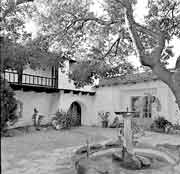
The barn built on Libbey's property was designed by the "architect
to the stars," Wallace Neff, and would win an award for the young architect.
The building was U-shaped with the main section of the barn in the center
and cow milking stalls running along one wing; a utility room with carriage
stalls was in the other. The centerpiece of the structure was a circular
tower that connected the wings together.
The building was constructed of adobe brick that was left exposed to
give it an aged appearance and the texture of stone; the bricks had been
made on the property. Strange, delicately pointed arches sprang from the
ground to pierce the base of the tower and frame the front portal.
A balcony across the front of the structure, constructed of rough wood
and a roof of hand-split wood shakes, suggested the adobe dwellings of
early California. The overall effect was beautiful.
Libbey did not get to enjoy his dream for very long - just two short
years after the barn was finished and before the house could be built on
top of the knoll, he died.
The arrival of William Lucking Sr. in 1927 to the Ojai Valley would
forever change the use of the Libbey barn and its surrounding 60 acres.
Lucking was part of the legal counsel for the Ford Motor Company and
he had family members living in The Ojai. When Lucking saw the property,
he became interested in the possibilities of purchasing it from the Libbey
estate. Returning to his home in Detroit, Lucking contacted Mrs. Libbey
to see if there was any interest in selling the Ojai ranch. Mrs. Libbey
agreed to meet with Lucking and an agreement was reached. The ranch then
became part of the Lucking Family Trust.
The first step in converting the structure to a pleasing home was the
hiring of local designer Austen Pierpont. Pierpont was gaining quite a
respected reputation for the attractive buildings of his design that were
being built around the valley, and it was only natural that Lucking would
hire this young man.
With the Libbey barn, structural soundness was the first order of business.
The building was gutted and all of the old cow stalls and the roof were
removed. The original structure had not been reinforced, so the walls were
strengthened in order to safely hold the heavy beam ceiling that was to
be installed.
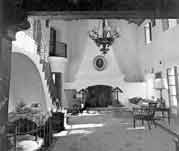
The great room with its two-story height and arched beam ceiling, which
was originally used for hay storage, was to have a formal fireplace domineering
one end, while a large balcony overlooking the large room covered the other
end. The wrought-iron and plaster staircase leading to the balcony had
Mexican tiles of a different design on each of the risers, which added
another touch of beauty to the room. The massive iron chandelier with its
parchment shades was a fitting centerpiece for the room. The concrete floor
was covered with a thick wood flooring that added warmth to the room.
The carriage shed wing was transformed into another large room used
for family dining. This room, not as formal as the main room, had a low
and heavy beamed ceiling, and the room was centered around a massive rock
fireplace, the opening of which was large enough to hold a table and chairs,
creating a warm nook.
Pierpont, talking about the furnishings for this room, said, "Mr. Lucking
got the idea of decorating the place by building heavy furniture of his
own design. He had a passion for things that were massive and very crude,
and possibly masculine. A whole truckload of oak was bought at Peoples
Lumber Company in Santa Paula, which had been stored from the old days
of the oil boom when it was used for the big wheels and walking beams of
the old-fashioned drill rigs. This lumber had been cured for 20 to 30 years
because there was no demand for it. It was two- to three-inch material
which was practically impossible to buy except at wholesale."
Pierpont had a large number of books showing authentic Spanish furniture,
and Lucking's furniture designs were influenced by these publications.
Pierpont said, "We did some great, heavy tables with long benches. They
had two and one-half to three inch tops and big turned legs, which required
a large lathe that was in Santa Paula."
The handmade floor tiles were brought up to the valley from the old
Alhambra Tile Company in Pasadena. The roof was of redwood shakes brought
down from Northern California. A bedroom wing was created, leading away
from the main room, down a long open breezeway and ending in a quaint round
stone turret.
The property had its own blacksmith shop and all of the intricate ironwork
was designed and made right on the property. The shop was well-equipped
with smithing tools, an anvil and bellows.
Staying true to Neff's design, Lucking included many torches of the
French Normandy style in the other separate buildings that he had Pierpont
design.
The first new building was the servants' quarters, so that caretakers
could be on the property year-round, since Lucking was primarily a winter
resident. The new building was constructed of concrete block, laid irregularly
and brushed with a cement coating to soften the harsh lines and match the
adobe block of the main structure.
The new coach house, now garages, with its charming gatehouse showed
the French Normandy design to the fullest. It so complemented the original
the original Neff design as to make it impossible to tell that it wasn't
part of the original plan.
Lucking had new stables built some distance from the house, and they
were also constructed to resemble the French Normandy countryside. Throughout
the property, small intimate courts were created by low stone walls around
the buildings. The property remained in the Lucking family until it was
sold in 1960.
In 1976, under the direction of Ojai architect Zelma Wilson, a master
suite was added to the house, extending the bedroom wing past the stone
turret.
This property has been unquestionably one of the great Ojai estates.
It has been a source of pride for the few lucky people who have had the
opportunity to call it home.
© 2000 The Ojai Valley News
Back
to the news |
|
WALLACE
NEFF'S AWARD-WINNING cow barn for Edward D. Libbey, now a palatial Ojai
Valley home.
|
|
INTERIOR
VIEW of the "great room" after William Lucking Sr.'s changes of the Libbey
cow barn.
|

|

