Hunt and
Grey wove their housing designs into the Ojai landscape
by David Mason
"The influence of climate on design is well shown in the admirable
work of Mr. Myron Hunt and Mr. Elmer Grey, that is illustrated herewith.
The class of buildings erected by the various orders were so well in keeping
with their environment that as the county grew and the people in the East,
attracted by the many advantages which the country offered, moved hither,
they naturally adopted a style so eminently fitting and artistically good."
- The American Architect, February 1915
The beautiful Foothills Hotel had originally attracted Mr. and Mrs.
Edward Drummond Libbey to the Ojai Valley. Libbey owned the Libbey Glass
Company in Ohio, and through its success, he was able to "winter" wherever
he chose. The Foothills Hotel had been recommended to him by his friend
Harry Sinclair, who had a winter home in the Ojai Valley.
After visiting the valley for two winters, the Libbeys decided that
they should have a home here - one where they could escape the harsh Ohio
winters. They hired the architectural firm of Myron Hunt and Elmer Grey,
the leading architects of the day, to do the design.
Hunt was born in Sutherland, Mass., on Feb. 27, 1868. His father was
a nurseryman and president of the Society of American Nurserymen; he was
also treasurer of the Society of American Florists.
Hunt attended Northwestern University and the Massachusetts Institute
of Technology. Upon graduation, he departed for an extended tour of Europe
with the goal of studying its architecture. Returning to America in 1896,
he worked in Chicago until 1903, when he moved to California.
Hunt was the first architect with an impressive reputation from east
of the Mississippi to settle permanently in Southern California. None of
the architects practicing in the small populated town of Los Angeles had
so much as a college education.
Hunt made his home in the town of Pasadena, but his office was in downtown
Los Angeles. By 1904, Hunt's practice was thriving and prospects were so
bright that he took on a partner, Elmer Grey, who had come to California
from Milwaukee.
In an article for the 1905 Architectural Record, Grey wrote: "Ornament
is not style, it is made up of the inherent quality in a building occasioned
by its plan, by its site, by local building materials, and by the life
that goes on within its walls."
Due to Hunt's father having been a nurseryman, it was only natural
that the son would also be interested in the landscaping that surrounded
the buildings that he designed. In The Los Angeles Evening News of Oct.
7, 1907, Hunt wrote: "The real California garden is on the border of the
desert We must accept the wilderness and use it as the background for our
picture, the setting for our jewel."
The idea of incorporating the garden into the architectural plans was
equally as important to Grey as to Hunt. In October of 1907, in The Los
Angeles Evening News, Grey wrote: "The best California bungalow schemes
involve a garden or large outdoor living space, incorporated as an integral
part of the plan."
Two early commissions in which Hunt and Grey would include the landscape
plan were the Ojai Valley foothill ridge homes of O.W. Robertson and Edward
Drummond Libbey.
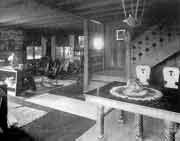
The Robertson home was designed in the Swiss chalet style, two stories
and finished entirely in natural wood. Stylized pine trees were painted
between the rafters and pine trees stenciled in green also adorned the
pale brown monk's cloth draperies. Other painted decorations included German
mottoes over doorways and a triptych panel above the entrance to the kitchen.
A log chandelier suspended from the open rafters by iron chains held wax
candles to illuminate the dining table. The stair balustrade was sawed
out to emulate the pierced pattern of the gable-end exterior balcony.
The cobblestone chimney added an additional element of charm. In 1909,
House and Garden magazine deemed the structure exemplary for its harmonious
blending with the valley landscape. The architects had incorporated a form
of pleasing, natural hillside gardening, and the rock wall bordering the
street also served to relate the structure to its setting.
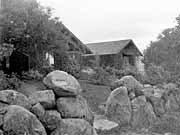
The Libbey house was quite a change from the Robertson design. This
house was one story, low to the ground, and planned as a winter home. It
was far more rustic than some of Hunt's other designs. Its broadly extended
roof sheltered the exterior board-and-batten walls. Similar board-and-batten
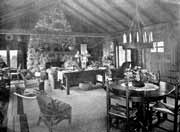
was used for the interior walls, and the gable roof was fully exposed on
the interior. The large living room was dominated by a massive rock fireplace
at one end, while the dining area utilized the opposite end. The hand-painted
ceiling depicted Indian designs on the beams. Around the exterior grounds
of the Libbey house, Hunt arranged huge boulders in a natural romantic
fashion.
After the completion of the Ojai houses, Hunt and Grey were hired by
Henry Huntington in 1910, and this commission would bring the architectural
firm much more publicity.
In 1902, Huntington had purchased the San Marino Ranch and had begun
to develop a park there. Spectacular gardens and acres of spacious rolling
lawns studded with native oak trees surrounded the site that Huntington
had picked for the house.
Hunt and Grey designed a U-shaped plan with the entrance being in the
center of the inner court. When finished, the building was the only house
in Los Angeles to be included in the 1914 book "Stately Homes of California."
Between 1919 and 1920, Hunt built a large library building to house
Huntington's magnificent collection of books and manuscripts. It was planned
so that additions could be built to the rear. The building also housed
Mrs. Huntington's collection of French paintings, sculpture and decorative
art. This became the first nationally important cultural complex to be
built in Southern California.
Also in 1919, one of Hunt's major challenges was the design of the
Rose Bowl. Up until this time, his only involvement with the Tournament
of Roses had been watching the chariot races that were held there in 1904,
which were inspired by the novel "Ben-Hur," and the designing and decorating
of a parade float for the Maryland Hotel in 1910.
The stadium, which was one of the world's largest, became a tribute
to Hunt's skills as an engineer, artist and architect.
Before Hunt's retirement in 1947, he had completed hundreds of projects,
including the 1918 house for Western author Zane Grey, the 1921 Santa Barbara
Ambassador Hotel, and the Los Angeles County Building for the Golden Gate
International Exposition held in San Francisco in 1939.
Committed to environmentally sensitive architecture, Hunt's designs
are as beautiful and inviting today as when they were first designed and
built by a true artist. The Ojai Valley has been rewarded with these two
prime examples of architecture that have been preserved by their owners
for many more generations to come.
© 2000 The Ojai Valley News
Back
to the news |
|
MYRON HUNT
AND Elmer Grey designed the Libbey house - 1915.
|
|
THE RUSTIC
living room in the sprawling Edward Drummond Libbey house - 1911.
|
|
THE INTERIOR
of the Robertson house - 1911.
|

|

