Harris'
design sits atop a hill overlooking the Ojai Valley
by David Mason
"Wood, swells, burns and rots. It is as variable, unpredictable and
unreliable as the human creature it shelters or warms not so permanent
as stone perhaps, yet permanent enough as human lives go."
- Harwell Hamilton Harris
California Arts and Architecture, May 1939
California at the dawning of the 20th century was a time of unhurried
changes. The Victorian era had survived the close of the 19th century,
and the sentimental tastes that had defined it continued to prevail for
some time into the new century.
In 1903, a baby was born in Riverside, Calif. who would grow up and
do a great deal to change the nation's thoughts from Victorian to modernism.
Harwell Hamilton Harris' mother was a school teacher, and his father was
an architect. In talking about his father years later, Harris would say
that, "He was a good architect, but he wasn't an outstanding one in any
way. He never thought of it as being something that you could be outstanding
in. I don't think that it was a subject that he was very strongly interested
in."
Graduating from San Bernardino High School, and then attending Pomona
College, Harris enrolled in the Otis Art Institute. Sculpture would hold
his interest for sometime. He had a desire to lose himself in his art.
Harris had ruled out architecture as a life interest for it did not constitute
a work of art, it was for practical purposes and too impure to be called
art.
However, while at the Otis Art Institute, he was treated to a visit
to Frank Lloyd Wright's "Hollyhock" house and was spellbound. The house
had low walls and wings that came toward you and away from you and were
paralleled with bands of hollyhock ornamentation, which was repeated above
the window line and ledges. Harris felt that the house was, indeed, a sculpture,
but on a completely different scale.
With a new desire to now join the architectural world, Harris was introduced
to the well-known architects Rudolph M. Schindler and Richard Neutra. Neutra
was in need of some help in the office and persuaded Harris to join them;
his first desk was a drawing board resting on an old trunk in the corner
of their drafting room.
In 1928, Harris helped Neutra with one of his first modern buildings,
the Lovell Health House. The experience gave him the true aspiration to
become an architect and, clearly, Harris was taken by the modern style
of architecture.
It was in 1932 that Harris received his first architectural commission
- from an old friend and classmate at the Otis Art Institute. He hired
Harris to design a house for him and his wife. The plan was L-shaped with
a courtyard, steel-framed, with wall panels and a flat roof, much like
the clear shapes and clean spaces of the Japanese houses - a quality that
became characteristic of all later Harris' designs.
Harris had seen many houses in California constructed with board-and-batten
exterior walls, and to him they did not appear cheap, but rather an inexpensive
form of construction. Left unpainted, they appeared even more Japanese.
In 1933, Harris noticed beautiful houses around the Pasadena area that
were low, one-stories constructed of redwood boards and battens. On inquiring
as to who the designer was, he was informed that they were done by brothers
named Greene. Harris had not heard of the brothers, but certainly admired
their work.
Jean Murray Bangs would become Mrs. Harwell Hamilton Harris in 1937.
With her interest in architecture, she had quit her job and became Harris'
full-time assistant. The Greene brothers would hold a fascination for her
as well, and she set out to view as many of the Greene brothers' buildings
as possible - and she was interested in learning if the architects were
even still alive.
Jean Harris studied every publication that she found on the Greene
brothers and uncovered all the information she could. She searched for
any trace of the brothers, looking through all the telephone books and
directories for any listing, but she found no help. Even the American Institute
of Architects could not give her any information on the brothers; apparently,
they had given up their membership in 1915.
Not giving up, Jean Harris was finally able to locate Henry Greene's
daughter, and she drove to her house. There, she also found the architect.
She inquired as to the whereabouts of the many drawings that he and his
brother had done over their years in business and was told that they had
left them all, perhaps as many as 400, in the garage of the last house
in which they had lived.
Inquiring with the owner of the house, she found that he had no objections
to her searching the garage for the drawings. And, so it was that in a
run-down cabinet in a rat-infested area of the garage, she found the many
drawings.
Jean Harris then had their friend Henry Eggers (the architect of the
Ojai home of historian and author David Lavender) photograph all of the
Greene and Greene houses and organized a traveling exhibition. She documented
the lives of these forgotten men and, subsequently, the information is
available to everyone. Through her efforts, the American Institute of Architects
bestowed a special award upon the now-famous Greene and Greene brothers.
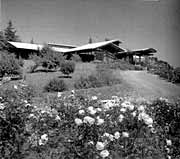
In 1946, Harwell Harris received a commission for a hilltop home in
Ojai Valley for Mr. and Mrs. Clarence Wyle. In the Wyle house, Harris found
that it would be more interesting to reveal the structure of the house
and, for this reason, the gable roof became a favorite new element. "I
like not having the boxed-in eaves that I usually had with the hipped roof,"
Harris said. By using rafters that were 2 inches deeper in the open sections,
he assured himself that they would never appear as if part of the roof
had been "blown off in a storm." The 2 inches would make the extension
appear bold and intentional. The extended rafters were dramatically exploited
in the Ojai house, which was being constructed in a mountainous region.
Harris presented a plan with four wings going out from the center of
the house into the graceful landscaping to afford each room a spectacular
view of the Ojai Valley. The plan also allowed for the major rooms to have
glass walls on three sides.
The living room was inviting with its built-in sofa, a modern inglenook,
and a warming fireplace. The built-in bookcases would add to the informality
of the great room, and the master bedroom with its brick fireplace helped
to recreate intimate spaces within the house.
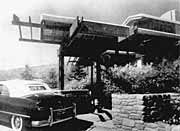
One gabled wing, a porte cochere reaching to the drive, had an exposed
roof construction overhead and a rock wall with built-in bench below. It
was a clear homage to the Greene brothers.
After World War II, the Harrises decided to make a change in their
lives. Harris accepted a position as director of the newly formed School
of Architecture at the University of Texas. He had taught at a number of
schools, but the thought of teaching on a permanent basis had never entered
his mind. Now, he was not only an architect, he was to be the director
of the entire school.
Jean Harris became involved with the magazine House Beautiful. She
wrote many articles for the publication and, for a time, was even listed
as food editor. Many of her pieces were about architecture and the modern
home.
The last years of Harwell Hamilton Harris' life were spent educating
young architects, and his art continues to draw the respect that it so
deserves.
"With its form the building satisfies the user's wants - conscious
and unconscious. It anticipates, it invites, it implements those wants.
So whatever the indweller now does he does effortlessly, harmoniously -
doing what great art does in music, in literature, in mathematics, in painting,
in sculpture: creating a great unity. Doing this is what makes architecture
worthwhile." - Harwell Hamilton Harris, 1977.
© 2000 The Ojai Valley News
Back
to the news |
|
THE CLARENCE
H. WYLE HOME, designed by Harwell Hamilton Harris, overlooked the Ojai
Valley - 1948.
|
|
THE WYLE
HOUSE porte cochere reaching to the drive with its exposed roof overhead
- 1948.
|

|

