Flood of
1938 was devastating to whole community
by David Mason
"The view of nature that Matilija Canyon presents has always been awe-inspiring,
but never more so than now, when the evidence of what nature can do when
in a wrathful mood is still manifest."
- The Ojai, May 5, 1938
The night of March 2, 1938, was a long wet one. The rains had been pounding
the small valley for a week, and in the last 24 hours, the downpour had
totaled up to 7.9 inches. The residents waited through the night, listening
to the roar of the water as it rushed over the rocks that were being washed
into town. They waited throughout the night for the first light of daybreak
so that they could assess the damage that was done during the last few
hours.
Morning brought with it the realization that the Ojai Valley was completely
cut off from the rest of the world. Telephone and telegraph lines were
down on the ground and out of service. All roads leading in and out of
the valley were either washed away or covered with tons of earth that had
washed down from the hills, making them completely impassable.
The small bridges in town withstood the torrents, which had the water
beating against them at a rate of 500 cubic feet per second. The river
banks were overflowing in many places and the water was being carried directly
into houses.
Signal, Ventura and Lion streets were virtual spillways as the water
raced down from Stewart Canyon too furiously for the runoff ditches to
handle. On Lion Street, the water had changed its course from the original
channel and was rushing down the middle of the street, causing the houses
on the east side of the street to be stranded on an island and the overflowing
water poured across Aliso Street, headed for the downtown block.
In the arcade, the Rockafellow's Pharmacy, now Bonnie Lu's Country
Cafe, was completely flooded from the rushing water. Many of the other
stores in the east end of the arcade were also in grave danger as the water
level continued to rise. The Buckner house, now The Herb Garden, was inundated,
the piano and other furnishings were being carried out as the water swirled
up knee-high.
With the quick thinking of Anton Sarzotti, the downtown stores were
saved. Sarzotti brought bales of hay into town, at his own expense, and
built a dam that diverted the water from doing any more damage to the business
block.
All of the local schools were closed for the duration of the storm.
The teachers and students were unable to reach the schools, for all of
the roads were quickly disappearing as the water was rising.
Ranches in the East End were also hit hard. The H. Waite Gerry orchard,
across Grand Avenue from San Antonio School, was cut by a deep ditch when
the water rushed through the orchard, taking with it orange trees and smudge
pots. The "dip" on Grand Avenue was piled with boulders in profusion, and
the beautiful hillside mansion of the Sam Barrett family, at the end of
Boardman Road, was surrounded with tons of mud as the earth gave way and
slid down the mountain.
The bridges crossing San Antonio Creek on Grand Avenue and Ojai Avenue
were completely washed out, effectively cutting off the East End residents
from the city of Ojai, and stranding them due to the Dennison Grade being
closed because of the mud and debris.
The floodwater went raging down the Ventura River, creating severe
damage to the Maricopa Highway and in Matilija Canyon. At Pop Soper's training
camp on the Maricopa, five cabins were lost to the stream and the two ends
of a nearby bridge stood forlorn, reaching for each other across 50 feet
of space, while the water flowed merrily along 20 feet below. The bridges
above Soper's were all left standing firm, although seriously undermined.
Had they not been reinforced by new supports less than six months earlier,
they would probably have not withstood the pressure.
In every spot where the river scoured against the bank of the roadway,
the shoulder had been washed away, leaving nothing between the pavement
and a 50-foot drop into the rocky stream. On one bridge, the underpinnings
had been so badly weakened that the highway workers had to fence off one-third
of the bridge, lest the weight of a car prove too much for it.
Everywhere trees leaned precariously with their trunks 5 feet deep
in debris. Heavy displaced boulders filled the streams - only hours earlier
they had been on a bank farther up the canyon.
At Wheeler Hot Springs, three cabins were lost, and across the highway
at Webb Wilcox's Cafe, now The Wheel, the first floor was washed away,
leaving the second floor on the ground in its place.
Road graders plied their way steadily up and down the hard-hit stretch
of highway. The 1,100 feet of road in the curve that led into the first
tunnel was completely torn away, leaving nothing but hillside where the
highway had been.
Farther up the Maricopa Highway, a new channel was cut through the
Wheeler Gorge campground, and all of the concrete viaducts over the creek
inside the camp were taken away, as well as a number of the picnic tables.
Many fine old trees and hundreds of feet of highway were destroyed in a
very few hours by the force of the once-gentle stream as it roared its
way toward more destruction in lands where the water had not flowed for
many decades, lands where homes and farms had sprung up.
As the Ventura River continued to make its way to the ocean, the water
crested on both sides, flooding the Rancho Matilija and cutting away the
banks on the Meiners Oaks side. Reaching the small town of Oak View Gardens,
it completely destroyed the houses that had been built along its banks,
washing them out to sea. Many daring rescues took place as people found
themselves stranded in the middle of rising water. Evacuees found a dry
room and a cot waiting for them in the Boyd Club in Ojai, where the Red
Cross had set up their relief center.
Everywhere you looked, there was destruction. Along the beautiful winding
Creek Road, many of the stately sycamore trees that had grown there since
the Indians populated the area were uprooted and moved downstream.
Finally, when the rain was over, an emergency road was cut through
to the Matilija for use by government vehicles. A detour of the Ojai Avenue
bridge was built temporarily just north of the destroyed bridge to give
the people living in the East End access to town. Damage to the roads was
estimated at $50,000, not including the Matilija Canyon road, which was
the worst spot in the whole area.
One property owner in Matilija Canyon returned to his home to find
the building and land gone, and in its place, a pond filled with trout.
When the water receded in Oak View, a 32-inch salmon was rescued from a
back yard.
The local Bank of America was even short on currency - because of the
interruption of the mail service, they had no fives, 10s or 20-dollar bills
on hand, although they said that they had "plenty of ones."
Some of the people living in the lowlands that had been evacuated were
unable to bring anything with them, and with the high water entering their
houses, practically nothing could be salvaged. It was the first time in
many years that the rivers had risen to this extent, and it plainly showed
that some measure of flood control was needed - after all, the property
that was removed to the Pacific Ocean was land that the county had been
collecting taxes on.
© 2000 The Ojai Valley News
Back
to the news |
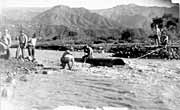
| PETE
MASON (left), the author's father, was a member of a crew which constructed
a temporary roadway across the San Antonio Creek on Grand Avenue - 1938. |
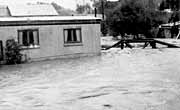
| THE
BACK OF THE ARCADE AS STORE buildings began to flood. The picture was taken
from the back door of what is today Bonnie Lu's Country Cafe - 1938. |
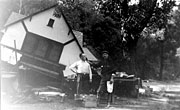
| THE
WEBB WILCOX CAFE, now The Wheel, on the Maricopa Highway, after floodwaters
completely removed the first floor - 1938. |

|

