|
Walker built homes on cutting
edge of day's design
by David Mason
"What man has learned about himself in the last five
years will, we are sure, express itself in the way he will want
to be housed in the future."
- Arts & Architecture
January 1945
After World War II, the newspaper and magazine were full of
advertisements for new homes being built for the returning servicemen.
They were often written so that it seemed as if the postwar houses
were, ultimately, what the war had been all about. Only rarely
did they use the old, cozy imagery of home and hearth. The magazine
House and Garden wrote in 1945 that modern architecture was "
a continuing struggle for growing liberty." They felt that,
"For some, if soldiers were to return to old-fashioned houses
and enclosed rooms, the fight would have been as good as lost."
In 1945, the magazine House Beautiful presented a house in Beverly
Hills, and wrote that " it was the house to which Johnny
dreams of marching home," and that this was " one of
the ideals these veterans have fought for and which they can
now look forward to attaining."
The same year, the popular magazine Arts & Architecture,
thinking it might stimulate the sale of their publication and
promote house sales, announced its Case Study program. It was
the California sun rather than the hearth that was at the base
of the program. A five-acre piece of land was acquired, a site
overlooking the ocean on the palisades above Santa Monica Canyon,
and nine architects were invited to join the program. There were
no restrictions on what type of houses they designed. The Case
Study houses were open to the public and introduced experimental
materials and the new modern forms. One of the finest designers
of this important postwar program was the 35-year-old Rodney
Walker.
Although he was born in Salt Lake City, Utah, in 1910, Walker
was mostly raised in the town of Ely, Nev. In his younger school
years, he showed a great interest in music, dramatics and sports.
Walker went to the Pasadena City College to study engineering
with the hopes of eventually transferring to California Institute
of Technology. His ideas were changed when he was lucky enough
to receive an athletic scholarship to the University of California
at Los Angeles (UCLA). At UCLA, Walker studied the arts and during
his senior year, he met and married his wife Dorothea, who was
also a UCLA student.
They built their first Los Angeles home in 1937. Rodney Walker
did the design, and he and his new wife did all the construction
work themselves, except for the electrical and plumbing. The
satisfaction of completing that first house instilled in Walker
that this would be the perfect occupation for him.
By the time America entered into World War II, Walker had designed
and built a dozen homes around Los Angeles for his clients. During
the war, with construction at a standstill, he worked for an
airplane company and continued his architectural studies. Every
spare moment was used visiting prominent buildings in the Los
Angeles area to familiarize himself with the style and techniques
of the city's major architects.
When the war ended, the young couple was able to purchase a parcel
of land in the hills above Beverly Hills and built a new house
for themselves on this important piece of real estate. The house
was extremely modern and had more than 2,000 square feet of floor
space with a sweeping view from the city to the sea. It was a
striking home.
When the Walkers were asked by Arts & Architecture if their
home could be used as one of the original Case Study houses,
they consented. The idea of the Case Study houses was that people
would not really understand modern architecture unless they saw
it, and they weren't going to see it unless it was built. The
Walkers' house would become the first house to be shown to the
public and to be covered exclusively in publications.
The Walkers enjoyed being in on the ground floor of such an exciting
time in California architecture. Within a short time, their home
was featured on the cover of the Los Angeles Times Home Section,
and the narrow mountain road leading to their home was congested
with an estimated 4,000 people driving into the hills to catch
a view of this spectacular home.
Walker designed two more of these Case Study houses. He used
his own construction crew and he joined them in the actual building
of these fine houses.
For the next 10 years, Walker continued to work in the Los Angeles
area, mostly building the houses that he had designed; however,
occasionally, he would do the design and just supervise the construction.
Most of the time, he preferred to do the actual building himself.
One of Walker's policies was the construction of two houses at
the same time. One would be for the client, and it got top priority,
while the second house would be built for "spec," primarily
to keep his crew busy while waiting for the plumber and electricians
to finish their jobs.
Walker refused to accept more than two jobs at a time. He enjoyed
his time "in overalls on the job," for it was during
these construction times that he felt that he was really able
to work out the details of his designs. During this period in
time, it wasn't considered professional for architects to do
the actual building themselves, but rather than give up the construction
end, which Walker felt was such an important part of his final
architectural product, he chose to remain a builder-designer.
Walker continued to work on various ways to make his houses truly
outstanding in design and, by using the latest products, he was
able to make the houses more reasonably priced so that everyone
could own and enjoy his art.
UCLA had a gallery showing of his works in 1948, and it brought
this designer to the attention of the Southern California media.
Home magazines were noticing this very talented designer and
many publications were featuring his work. House Beautiful worked
for a solid year, photographing the Walker house in the various
seasons and holidays in order to devote an entire issue of the
magazine to this modern home. After the publication hit the stands,
the Walkers received mail from all over the world. The people
of the country were ready for a change, and this new modern design
was very exciting to them.
In 1955, the Walkers took time off to travel north to Ojai. Their
first visit would cause them both to fall in love with the serenity
of this valley. The thoughts of purchasing property here became
a reality in a very short time.
Their first Ojai property, bought with the idea that it would
be used for a weekend home, was an older Victorian-style house
on North Signal Street. The remodeling job of this house, featured
in Better Homes and Gardens, brought the artistic family even
more recognition. Their love of the valley was so strong that
in 1956 they decided to make Ojai their permanent home. They
felt that it was a perfect place to raise their five children,
and they wanted to get involved in keeping the Ojai Valley the
wonderful place that welcomed them when they first arrived.
During the next two years, Walker finished up the commitments
he had started in the Los Angeles area and started accepting
a few designing jobs in the Ojai Valley.
One of his early designs was a Thacher Road weekend house for
Elsa Pehrson, a doctor and resident of San Francisco, which was
built in 1957. The house is L-shaped with wide overhangs. It
is constructed of concrete block and floor-to-ceiling glass walls.
The house was oriented on the lot to take advantage of the mountain
views, and it captured the excitement of the period.
Walker then decided to build another house for his own family
on a large parcel of land on the west side of the Arbolada. The
house would be his masterpiece. It sat on top of a low hill that
had a breathtaking view of the Ojai Valley. Hexagon in shape,
it was constructed of steel and glass. The exterior walls were
totally made of glass to provide for an uninterrupted flow from
the interior rooms to the outdoor living areas. It is truly a
modern palace.
At the same time, another commission had come his way - the 1959
Ojai Valley home for Dr. David Harvey and his family. This house
was also constructed of steel and glass and featured a prominent
projecting roofline on both the front and back. Full-length glass
walls produced an open effect. This spectacular building was
featured in Sunset Magazine and the Los Angeles Times.
Another Ojai home was built for Dr. Kurt Semmel. This single-story
building features a modern massive pointed roof that sweeps upward
and out, extending over a raised wood balcony. The wide brick
chimney provides a corner feature with tall glass walls on either
side, so that a view of the Ojai Valley and the rugged landscape
below can be enjoyed from inside the house. Walker's attempts
at drawing the outside in, through the use of glass walls, was
very successful.
Once Walker's own personal home and the commissions were completed,
he decided to take a rest. The family departed the valley for
a year's trip around the world. During this time that the family
was together, Walker decided to retire from the business of designing
houses and to work more toward protecting the quality of life
that he had come to enjoy in the Ojai Valley.
One of his local projects was the re-opening of The Oaks Hotel.
He spearheaded the idea of getting 200 local citizens to chip
in and purchase the hotel block that was standing in the center
of town. He served as chairman of the board of the hotel for
several years, until 1971, when he decided to retire from civic
affairs.
In 1971, the Walkers opened The Cello Collection, an interesting
gift shop in the downtown section of Ojai. Rodney Walker had
become an expert in the art of designing gold and silver jewelry,
and his works were featured in their stores, both here and in
Montecito.
The Walkers purchased condominiums in the Hawaiian Islands and,
with the yearly decorating and other maintenance of the condominiums,
and the jewelry that he was designing, Walker was able to fulfill
the creative and artistic desire that had been the love of his
life.
The beautiful homes in Southern California constructed by this
famous designer are highly respected by their owners as the great
creation of art that they are. One yearly reminder of this highly
respected gentleman is the Christmas lanterns hanging in the
arcade, which were designed by Walker.
© 1999 The Ojai Valley News
Back to the news
|
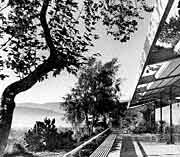
|
THE WALKER
FAMILY home overlooks the Ojai Valley - 1960. |
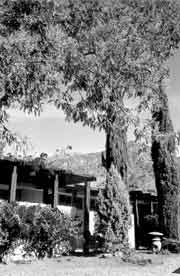
|
THE SPRAWLING
Thacher Road house designed by Rodney Walker in 1957. |
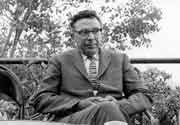
|
RODNEY
WALKER, was known for his work as an influential member of the
Southern California Post-War Modern Architecture Movement - 1962. |
|

